
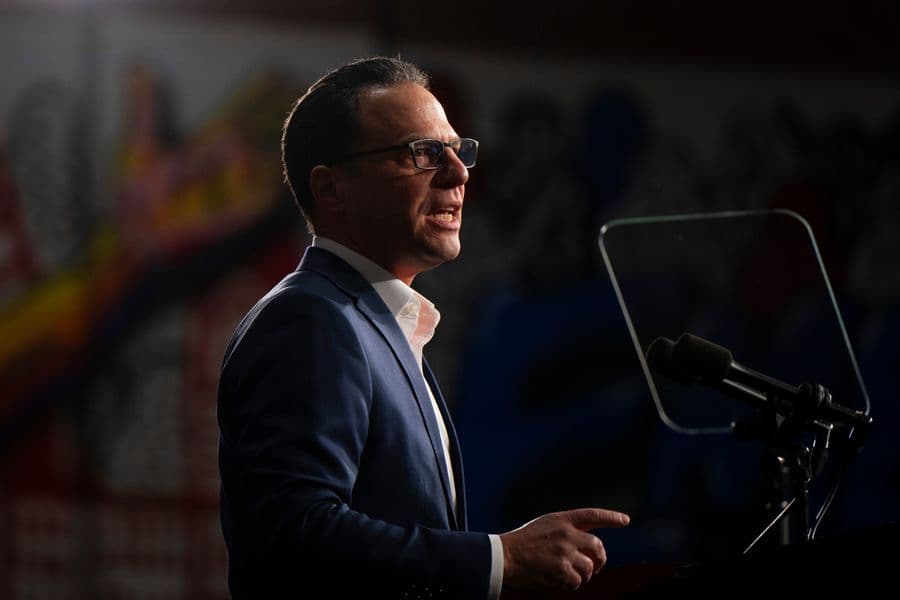
Will Shapiro's PA Success Translate at the National Level?
Last updated 06:36 PM EST • Read time: 6m
Review: Where We Keep the Light: Stories from a Life of Service, by Josh Shapiro (Harper, 272 pp., $30)
Josh Shapiro clearly wants to be president. Like most political memoirs, his memoir says as much what he thinks about the path ahead as an accurate rendering of the past.
Shapiro embraces his faith, believes in government as a force for good, and casts himself as a pragmatist with real bipartisan appeal. It’s not hard to imagine this path to the White House. After all, it’s the one traveled by Joe Biden in 2020. Will that lane still be there in 2028? Will he be the one in it? Time will tell.
To paraphrase the political journalist John Baer, what it takes to be successful in a conservative and parochial state like Pennsylvania rarely translates to national success. Biden was born here but he practiced politics elsewhere. James Buchanan seized the brass ring and then steered our country into a catastrophic civil war. More recently, governors and senators alike have discovered that mastering the state’s politics rarely sets you on a path to national success. We have entrenched special interests and a disengaged citizenry that skews whiter and older than the national average. Success here tends to leave you with a closet full of skeletons and feet of clay.
Case in point: the book begins with the firebombing of the governor’s mansion just after a Passover dinner. Shapiro quickly mentions October 7th, and the rising tide of anti-Semitism that took him to the University of Pennsylvania to protect Jewish students. Rightly or wrongly, this has cast Shapiro as a staunch defender of Israel in its war. The war, and the framing of anti-Israeli attitudes with anti-Semitism, has become radioactive among younger voters and many older ones.
Will this be a problem for Shapiro in being re-elected in Pennsylvania? It’s hard to imagine as he has cleared the field of contenders. Would this reputation hurt him in a Democratic primary for president? Hard not to imagine.
As Shapiro puts it, “the reason I have earned the support I have from Pennsylvanians is because I have at times been willing to take different positions [from the Democratic Party] because they’re what I believe. Because I reflect the common-sense sensibilities of my home state.” For what it’s worth, that sounds similar to what Gov. Robert Casey, Sr. said about his pro-life views in 1992.
Shapiro’s greatest triumph was trouncing a far-right Republican candidate, state Sen. Doug Mastriano, when he first ran for governor in 2022. Shapiro shares that a black Baptist preacher talked with him about the need to demonstrate his faith: “Real religion is … moving toward hard places and people in need, not away from them. You are doing that. This is what you live. That’s real politics the way [the Biblical] James talks about real religion. This is how you need to talk about real freedom – the ways in which you are bearing it out.”
In Shapiro’s words, he and Democrats:
are for real freedom. Real freedom is when you see the potential in a young child in North Philadelphia so you invest in her public school. That is real freedom. Real freedom comes when we invest in that young child’s neighborhood to make sure that it’s safe, so she gets to her eighteenth birthday. That’s real freedom. Real freedom comes when we put technology in her schools and open up her eyes to the possibility of being a welder and send her to a union apprenticeship program and believe in her so she starts a small business right here in North Philadelphia. That is real freedom. Real freedom comes when she hires a whole bunch of people that were never going to have a shot before. They go on to marry the people they love, worship how they want, live in a community that is safe, live in a place that respects them.
This is Shapiro at his most aspirational. Like the man himself, the writing is a bit stiff, and the sequence of events is likely true but also feels contrived.
Left unsaid is that his opponent ran arguably the most disastrous gubernatorial campaign in Pennsylvania history. Doug Maistriano raised so little money that when you heard his voice it was in an ad run by Shapiro. Shapiro ignores how he cleared a path for Mastriano by running ads attacking him, raising his stature with that party’s faithful. In practice, Shapiro has sharp elbows, though that goes against the brand he is building.
He does, however, sharply criticize Kamala Harris’ team when he was considered as her Vice President. Apparently this chapter is in response to her book, 107 Days, that contains “blatant lies” about him.
The panel also spent a lot of time asking me about Israel. Why had I taken such a hard line on the protests happening on college campuses, particularly at the University of Pennsylvania? I had been critical of the protestors who were vandalizing the campus, assaulting and intimidating Jewish students, and shutting down the main quad. The people vetting me didn’t seem to like what I had done. I told them that the safety of students on campus had been threatened, and I would take that position to protect them, or any other student group who’s [sic] safety was at risk, any day. That many campuses had failed to maintain the balance between free speech and the safety of students on campus. I wondered whether these questions were being posed to just me – the only Jewish guy in the running – or if everyone who had not held a federal office was being grilled about Israel in the same way.
Harris allies (almost certainly) leaked the story that Tim Walz was also sharply questioned about China because of his time there. Shapiro’s account is the kind of story that endears him to moderate Republicans in Pennsylvania. However, I’d argue that it will do him no favors if he does have national aspirations. While Harris is unlikely to be the nominee a second time, she has ardent supporters and allies.
But knowing when to grin and bear it, and when to throw an elbow, is one of the finer points of life in politics. Only time will tell if this is a tempest in a teapot, a strategic blunder, or clearing a lane.
Shapiro articulates a vision of America, and a version of himself, that deserves to be true.
“I love public service. Every single day, I am grateful that I get to wake up and do it. There’s nothing in this world I’d rather do,” he writes. “I know how fortunate I am to be here, and I’ve worked so hard to get to this place. I also know that I am here in service of the people of Pennsylvania, and that work fills me with such great purpose. It’s my goal and my duty and my honor to put in the work and to give them my full time and attention. I wouldn’t do it any differently.”
John Hinshaw is a Professor of History at Lebanon Valley College.

Platner Says He Won't Be an 'a–hole' Like Fetterman in Senate
By Tara Suter, The HillBlame Pennsylvania for the Gerrymander Mania
By Guy Ciarrocchi, RealClearPA
What Chris Rabb's Win in Philly Means for Fetterman
By Sam Janesch, InquirerVoters Signal They're Done With MAGA Chaos
By Mark S. Singel, PennLive
Republicans: Pre-Canvassing Bill 'Lets Dead People Vote'
By J. Kramer, Center Square
Pennsylvania Today
Featuring the latest pennsylvania news
RCP Today
Top stories on RealClearPolitics
Investigations Today
Latest investigations news
Defense Morning Recon
Featuring the latest news