

Shapiro Wants Us to Know He Does the Work
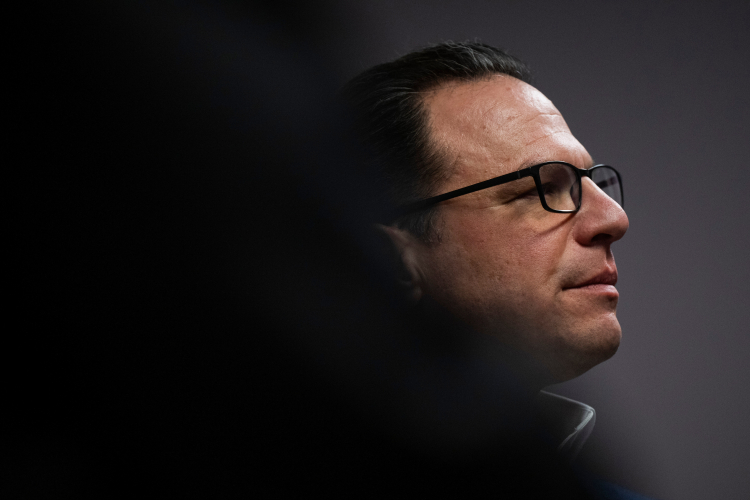
Political memoirs are applications for higher office disguised as recollection. Josh Shapiro’s is better than most because it mercifully does not pretend to be anything else. It is a workmanlike portrait of a governor who wants to be seen as serious, devout, and ready for a larger stage and has always presented himself as such. At fifty-two, he is still young enough to be marketed as a next-generation Democrat, and the book is plainly part of that content marketing.
It opens with the April 2025 firebombing of the Pennsylvania governor’s residence after a Passover seder — “seventy-five or so guests” in the State Dining Room, holiday candles lit, the Haggadah completed, the family watching Seinfeld (surely the greatest secular Jewish sitcom of all time) before bed. Then banging on the bedroom door: “Get up! Fire!” Smoke in the hallway. Kids piling into Suburbans. The symbolism, with darkness juxtaposed against light, is already thick. Shapiro knows how to set a scene so that outside observers see only the man he wants seen.
The sports sections do a lot of heavy lifting on that front, too. Shapiro wants it on the record that he was not only the smart Jewish kid from day school. He had “a hoop in the driveway where we'd obsessively play basketball.” He was a pitcher in Little League, with posters of “Dr. J and Michael Jordan on the wall behind my bed in my room.” He played point guard on a championship team at Akiba Hebrew Academy, scored sixteen points in the title game, and teammates called him “The General” because he “called the plays and told my teammates where to be.” He was, he insists, “usually able to see how things were going to play out on the court before they happened.”
For Shapiro, the sports material answers a visual and political problem. He is not an obviously imposing national figure in any sense. IMDB lists him at 5’8”; another source guesses 5’9”. The claim that he would be the shortest president since James Madison is at best unproven, but certainly not out of the realm of possibility. Madison stood 5’4”, but Martin Van Buren and Benjamin Harrison were both 5’6”, and several later presidents were commonly listed at 5’7” or 5’8”. Shapiro would likely fall in their range, not Madison’s. In a party whose two likeliest 2028 rivals are Gavin Newsom (tall, tanned, well-coiffed, and willing to brag about playing college baseball even if he never actually did) and Kamala Harris (age-defyingly attractive and boasting all the advantages of incumbency in the primary electorate if not at the ballot box), this matters more than most would admit.
At sixteen, Shapiro spent four months in Jerusalem during Akiba’s junior-year program. He describes Ben-Yehuda Street after Shabbat – “a cobblestone street on a hill that's teeming with crowds and filled with life, where people spill out of restaurants and bars, music plays, young Israelis and visitors meet up with friends.” At the Western Wall, wearing “baggy khakis that had about eight thousand pleats — it was the nineties!” he writes that he put his hand on the stone and found it “cool and worn, like you could feel the millions of hands that had been placed there before you … it was the first time I could feel faith.”
Of his upbringing, Shapiro states that “two things can be true: I had a happy childhood and, at points, an unhappy childhood home.” His mother grew up unsafe, “in her extremely unstable childhood home,” with “a father who left when she was just two” and “a series of stepfathers.” That trauma, as those of us who endured such childhoods know all too well, is a fertile field for instability, conflict, and anxiety. “At a young age, I knew how to spot a brewing problem from a mile away, almost instinctively. My siblings and I thought that if we were good, we could stop the chaos and the yelling.” He shielded his younger brother and sister, tried to hold the household together, never brought other kids inside “for fear of what they might see or hear.” Then he found, in wife Lori’s family, a household without yelling and with ordinary conflict handled in an ordinary way, everyone just sort of getting along.
The Hawbaker chapter represents the clearest example of how Shapiro, then the state’’s attorney general, actually can get big things done. He explains how Glenn O. Hawbaker, Inc., one of PennDOT’s biggest contractors, systematically stole from its workers’ wages and retirement funds. The scheme worked like this: on a prevailing-wage contract, Hawbaker would claim to withhold, say, five dollars per hour for health care when the actual cost was three. The difference went to executives. Then, enriched by the theft, the company underbid honest competitors – “for a road project that should cost $100 million, they would come in at $90 million, win the bid because they would make up the difference by stealing workers' pay.” The book gives us some nifty little capsule profiles of the impacted workers. Agnes Huber was a pipe layer whose “thumbs had slid off their bones by about a quarter inch” from years of shovel work. Tim Lewis, a superintendent, went to his accountant before retirement and was told his 401(k) couldn't possibly be all he’d earned. Harry Ward, a bridge worker, kept a notebook logging every shift and noticed the company’s numbers didn't match his.
By April 2021, relying on what Shapiro calls “great team legal work with an assist from Harry’s notebook,” his office charged Hawbaker with four criminal counts of prevailing-wage theft, which the attorney general’s office called the largest such case on record in the United States. The company pled no contest. Shapiro insisted that the money go to workers, not the state treasury, and imposed his own deadline: Christmas. “A week before Christmas,” he notes, “Hawbaker paid more than $20 million in stolen back wages to more than a thousand Pennsylvania workers.” One detail he omits – and he is of course justified in doing so, because it’s his book – is that Hawbaker has received hundreds of millions of dollars in PennDOT contracts since he has become governor, hopefully employing better payroll practices since that rather significant slap on the wrist.
Indeed, this relatively short book does expose Shapiro’s relatively thin record. While he has been in politics a long time – state representative at thirty-one, county commissioner at thirty-eight, attorney general at forty-three, governor at forty-nine – he can still read as a scrappy newcomer finding his footing rather than a seasoned pro. He long had what I called in a piece for RealClearPennsylvania an “Obama-lite rhetorical style” – the carefully measured uplift, the habit of “appropriating Obama’s stump-speech aesthetics.” That piece was mainly about Shapiro’s penchant for secrecy (deleted emails, a private calendar, redacted invoices, a climate working group that met for five months without public notice), but a few insiders later told me the Obama-lite label was what actually landed. Shapiro’s social media delivery and stump cadence shifted noticeably afterward.
When it comes to Israel, though, Shapiro doesn’t play things close to the vest. During Kamala Harris’s vice-presidential vetting, he refused to back down. “With total respect and understanding,” he told the vetting panel, “I'm not going to apologize for who I am or for the positions I’ve taken over the years.” When they pressed him on his criticism of campus intimidation at the University of Pennsylvania, asking whether his stance might create problems in Michigan, he told them he had close relationships with all faith communities in Pennsylvania and was “not afraid to walk into any room.” The panel, he says, seemed unconvinced. “I was getting the feeling from the people around her on the vetting team that picking me as her running mate was something they thought they maybe should do, but they had reservations.”
It is the only moment in the memoir where Shapiro, ever the political worker, sounds like he might actually walk away from a political job. U.S. Senator Catherine Cortez Masto later called to explain that as vice president his job would be “to support the number one, to do what she says and to listen. I wouldn't be a decision maker.” Shapiro understood the message, but could he have merely listened when it came to Israel? Compare fellow presidential candidate Gavin Newsom’s recent nonsensical flip-flopping. Newsom called Israel “appropriately” described as “sort of an apartheid state” on Pod Save America earlier this month, then told Politico he regretted the word, said he “reveres the state of Israel,” but would not directly answer whether he considers himself a Zionist. While Shapiro isn’t in John Fetterman’s league as a no-questions-asked backer of the Netanyahu regime, he certainly wouldn’t make any radical alterations to America’s special relationship with that country.
Most important, though, Shapiro wants it known to all and sundry that he’s the most campaign-ready Democrat who can still win a purple state in a presidential election, that he’s the sort of governor who believes government should do visible things for ordinary people. He knocks doors, rides snowplows, coaches youth basketball. Even during the VP vetting media circus, with helicopters over his house and cameras on his kids shooting baskets in the driveway, he tucked in a parenthetical, salt-of-the-earth boast: “I’m still deadly from mid range even at 52.”
Is that enough? For now, probably not. Pennsylvania voters still like him as governor. Quinnipiac found in February that 56% approved of his job performance and only 29% disapproved. The same poll had him leading Republican Stacy Garrity 55 to 37 in the 2026 governor's race. Cook Political Report now rates the contest Solid Democrat, and Spotlight PA reports that Shapiro raised $23 million in 2025 and ended the year with $30 million in his war chest – a fundraising advantage over Garrity of roughly 15-to-1 ($2.5 million of it from Mike Bloomberg alone, a well of wealth he might be able to return to in a national race given their ideological similarities). Yet that same Quinnipiac survey found Pennsylvanians slightly negative on the $64,000 question (though that 1950s game-show dollar figure would be closer to $773,000 with inflation): only 40% said he would make a good president, while 43% said he would not.
That is why I maintain that a normal reelection win in 2026 will prove very little. An incumbent governor with this kind of dough, these approval numbers (as against Trump’s polling freefall), and this electoral math is supposed to win. However, if Shapiro wants this memoir to function as more than a handsome bookend for a shelf in some cabinet office he is handed in the distant future, he needs more than another Pennsylvania victory. He needs a triumph on the order of what his home-state Philadelphia Eagles did to the heavily favored Kansas City Chiefs dynasty two years ago, or the kind of 60-40 beatdown that wildly popular Ohio Gov. Mike DeWine delivered to Nan Whaley in 2022. For what it’s worth, Where We Keep the Light does exactly the job it sets for itself: here is Josh Shapiro, the hard-working man of the people. The unresolved question is whether merely winning a favorable race in Pennsylvania will get that narrative across to the rest of a beleaguered and distracted nation.