
The True Story of Pennsylvania's Amish Vote
Last updated 02:28 PM EDT • Read time: 7m
In the lead-up to the 2024 presidential election, viral social media posts claimed that record numbers of Amish registered to vote. For example, one post that received national attention claimed that as many as 180,000 Amish registered to vote in Pennsylvania’s Lancaster County.. Such a claim was echoed by former Trump advisor Jan Halper-Hayes. Even Elon Musk, reacting to media posts that the Amish supported Donald Trump at the ballot box, noted that, “The Amish may very well save America!”
But to what extent did members of the Old Order Amish community in Lancaster County vote in the 2024 election? And for those who did vote, could they have swayed the outcome of Pennsylvania’s 19 Electoral College votes?
We have researched the phenomenon of Amish voting in presidential elections for more than 20 years. Despite claims that the Amish could have been a major voting bloc, our recent analysis of the 2024 election in Lancaster County demonstrates that the Amish turnout amounted to a few thousand votes. Furthermore, the population of Amish in Lancaster County, let alone the entire Commonwealth, is not large enough to corroborate some social media claims. But that is not to say that the Amish vote is meaningless. Indeed, a few thousand votes in a close election could be decisive. Remember, the 2000 presidential election was decided by 537 votes in Florida.
Should the Amish Vote?
Admittedly, this is a big question, and one that some Amish grapple with. Just because Amish have the legal right to vote, doesn’t mean they will. That may sound unusual to someone who isn’t familiar with Amish culture and society. So, what’s to prevent them from voting?
The decision to refrain from voting is largely attributable to their religious world view. The Amish, and many other Plain groups, are influenced by what is referred to as a “Two Kingdom Theology.” That is, Plain groups often make a distinction between citizenship in the secular world and the Kingdom of God. This world view is heavily influenced by their interpretation of the Bible, particularly John 18:36 in which Jesus states that, “My kingdom is not of this world,” and Matthew 22:22, “Give therefore to the emperor the things that are the emperor’s and to God the things that are God’s.” These teachings of Jesus help to underscore a distinction between what the secular world requires of its people and what God requires of his people. In brief, the Amish, and other Plain groups, use this as a basis from refraining from activities that are closely associated with the secular world – including voting and political participation.
But it’s a little more complicated. There are also concerns that, given the Amish views of pacifism, it would not be consistent with Christian values to vote – particularly for president. After all, the president is the Commander-in-Chief of the armed forces and wages war and exercises the use of force from time to time. Additionally, there are concerns among some Amish that if they were to be involved in politics and matters of government, that will erode their ability to maintain their separate status of “pilgrims” or “strangers” in a foreign land on their heavenly journey to God’s Kingdom. In short, if they can tell the government what to do, the government could, in turn, tell the Amish what to do. That could jeopardize their way of life. At least, that’s the concern among a non-trivial number of Amish.
Ultimately, at least in the Lancaster Settlement, voting is an individual decision – one that is based upon their interpretation of Amish cultural norms and Biblical teaching.
Amish Demographics
Before digging into the voting data, it’s important to understand how large Pennsylvania’s Amish population is, and how large the population is in Lancaster County. Across all of Pennsylvania, the Old Order Amish population was approximately 92,660 in 2024 – making Pennsylvania the state with the largest Amish population. Within Lancaster County, the entire Amish population was nearly 35,700. The Lancaster Settlement, which extends beyond Lancaster County into neighboring counties, is the largest Amish settlement in the country.
But these figures include all Amish, including those under the age of 18. Unlike the non-Amish population, Amish communities have a greater share of young people. In fact, approximately half of the Amish population at any given time is under the age of 18.
This is important for two reasons. First, it means that roughly half of the Amish population is not even eligible to register to vote, let alone go to the polls. Second, because the Amish have such high birth rates and consist of a large number of young people, their overall population nearly doubles every 20 years.
Did the Amish Vote?
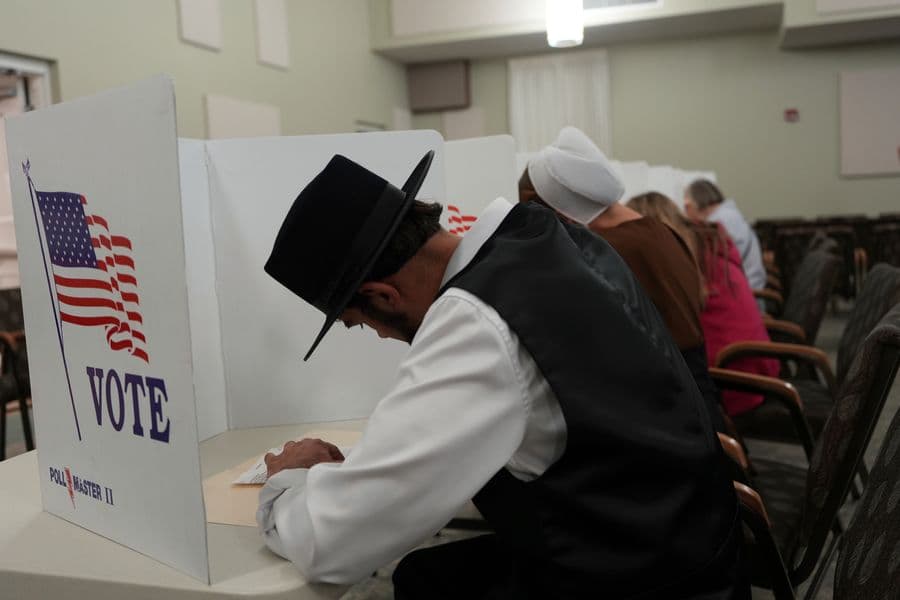
Yes, members of the Amish community voted in the 2024 presidential election. To make this determination, we worked with student researchers to painstakingly cross-reference voter registration rolls with Amish church directories. By our count, there were 2,568 Amish who voted in Lancaster County. We estimate that there were 17,490 voting-age Amish adults in Lancaster County in 2024, meaning that 14.68% of all Amish adults voted. But there were more who registered to vote. In total, we identified 4,454 Amish who we registered to vote. That means that of all registered Amish voters, 1,886 did not vote, for whatever reason.
Of course, voting records do not indicate who a particular voter voted for. But, given the fact that about 95% of registered Amish voters indicated a Republican Party affiliation when they registered, coupled with anecdotal evidence, it seems safe to assume that the overwhelming number of Amish votes went to Republican candidates.
While every vote counts, given that President Trump won Pennsylvania by roughly 120,000 votes, the Amish were far from a decisive bloc of voters in this election. Indeed, Trump’s margin of victory eclipsed the entire Amish population in Pennsylvania.
What Does this All Mean?
We have also tracked Amish voting in the 2004, 2016, and 2020 presidential elections. Interestingly enough, though the Amish population was smaller in 2020 and there were slightly fewer registered Amish voters, the raw number of Amish voters who turned out in that election was slightly higher than what we observed in 2024. In the 2020 presidential election, 2,940 Amish voted in Lancaster County. This was a record high number when compared to the 2016 election (1,019 Amish voted) and the 2004 election (1,342 Amish voted).
Just because there was a decline in the number of Amish who voted in 2024 does not mean that Amish voting is “on the decline.” In all likelihood, there will be a consistent portion of the Amish community that votes in future elections. Even if the percentage of the Amish adult population that votes remains relatively small (below 20%), as noted above, the Amish population is expected to grow markedly in the coming decades. It may be the case that the raw number of Amish voting will also increase, even if the overall percentage of those who vote remains steady. Only time will tell.
For now, it is safe to say that the claims of a massive surge in Amish voters were clearly overblown. However, in a tight election – either at the state or local level – a few thousand Amish votes could make a difference.
Steven M. Nolt, Ph.D., is Director and Senior Scholar, Young Center for Anabaptist of Pietists Studies, and Professor of History and Anabaptist Studies, at Elizaethtown College. Kyle C. Kopko, Ph.D., J.D. isAdjunct Professor of Political Science at Elizabethtown College.

Platner Says He Won't Be an 'a–hole' Like Fetterman in Senate
By Tara Suter, The HillBlame Pennsylvania for the Gerrymander Mania
By Guy Ciarrocchi, RealClearPA
What Chris Rabb's Win in Philly Means for Fetterman
By Sam Janesch, InquirerVoters Signal They're Done With MAGA Chaos
By Mark S. Singel, PennLive
Republicans: Pre-Canvassing Bill 'Lets Dead People Vote'
By J. Kramer, Center Square
Pennsylvania Today
Featuring the latest pennsylvania news
RCP Today
Top stories on RealClearPolitics
Investigations Today
Latest investigations news
Defense Morning Recon
Featuring the latest news