
Data Center Politics Arrive in Small Town PA
Last updated 09:35 PM EDT • Read time: 6m
AI is upending the world. Tech companies are investing vast sums, believing whoever becomes the leading provider will dominate the economy for a generation. The Wall Street Journal estimates annual investments from five companies will top $800 billion this year, with more than a trillion planned for next year.
Top executives, such as Elon Musk, promise a future where rising productivity creates so much abundance that work becomes optional. While some of these predictions are hype, AI is rapidly reshaping the internet, some industries, and the modern battlefield. As a result, data centers are being built throughout the country at a dizzying pace.
A recent Pew survey found that Democrats and younger voters were more critical about data centers, with more Republicans unsure about them. Another found that voters across party lines are increasingly hostile to large data centers, especially if they are being built nearby or are linked to rising prices. More than 60% of voters believe AI will result in job losses. Only about a third had some trust in AI, while 58% had no or little trust in it. These results are the same for Democratic and Republican voters.
Consequently, the gold rush to build data centers has created a mismatch between voters and local and state governments.
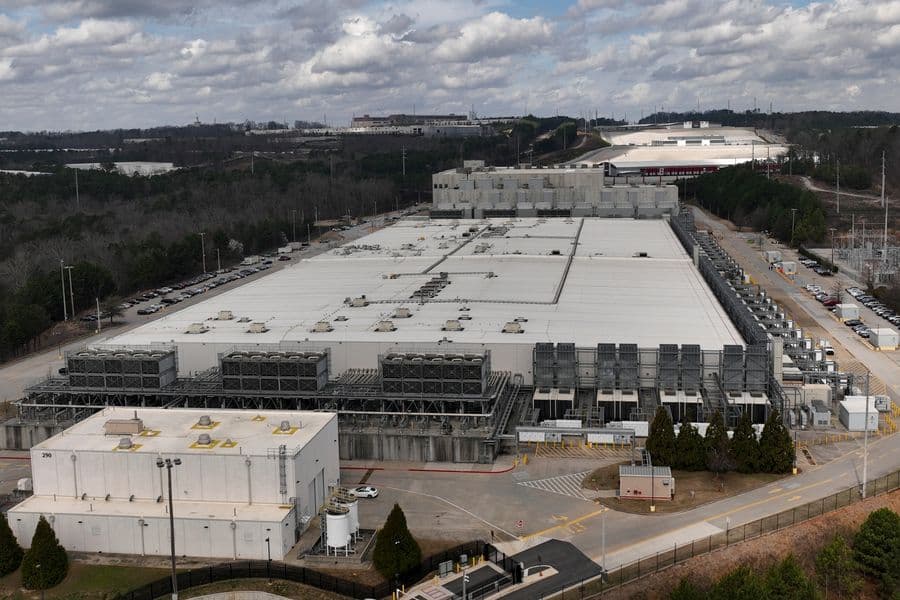
This is the backdrop for why a $1.7 billion data center for Lebanon County’s South Annville Township has roiled local politics. Developers promised that the 100-acre site would generate low-levels of noise, rely on a closed-loop system for water cooling, and generate millions of dollars annually for local schools and government.
When South Annville officials first received the proposal, it was treated as utterly routine and beneficial. One county commissioner observed that “the data centers are necessary because everybody has a cell phone and AI is part of the future.” But as the Center Square reported, “an avalanche of opposition has appeared in South Annville.” The land for data center would need to be rezoned for industrial usage, and residents from a nearby neighborhood in Annville borough raised concerns about noise and the effects it would have on residents, students, and property values.
This week, the company withdrew its zoning application. One of the organizers told me that while many of the organizers were liberals, many people who supported them were Republicans. Organizers avoided, and batted down, ad hominem attacks or conspiracy theories, which some elected officials appreciated, as passions were running high.
Throughout the efforts to stop the data center request, citizens packed the zoning board meeting. The activists were spirited, but civil. In other Pennsylvania counties, the Center Square found that meetings devolved into shouting matches and local officials having police remove speakers. One resident told me that it doesn’t matter what the company promises, since once the data center is in place, the company will generate whatever noise they want or pump the water table dry.
Large data centers produce substantial hums that sound like a freeway that one Virginia resident compared to traffic on a highway that never stops. Even those who support AI complain that the noise is disruptive, and companies are unresponsive.
Likewise, data centers consume considerable amounts of water. Residents of Fayetteville, Georgia found that their water pressure was unusually low. The culprit was a nearby data center, which pulled thirty million gallons of water, at first without paying. (The company said this was for construction of the center, not to cool the servers.) One resident fumed to Politico that “It’s just frustrating to see them come into our community and run all over us like the citizens don’t matter, and then they’re above the law when they do break it.”
Data centers represent half of the increase in electricity demand in the country. Thus, data centers are easy to blame for rising electricity prices.
Until now, most governors have been supportive of data centers. After all, most if not all governors seek to drum up investment to encourage job growth or strengthen the tax base. At first blush, it’s not clear why data centers are any different than, say, a manufacturing plant for auto parts?
Unlike an auto plant, data centers do not create many jobs beyond construction. Moreover, while Americans love technology, they have been slow to warm up to AI. The rollout of AI into daily life has been pushed by tech companies adding AI into browsers, phones, and apps, so it is hard to avoid using it, even if you try. This is quite different from the commercialization of the internet, the Apple iPhone, or GPS where consumers eagerly adopted the new technology.
Among those that use AI at work, the Wall Street Journal reported that workplace surveys indicate that work is becoming more intense, leading to what some researchers call “AI brain fry.”
In political terms, AI is an extension of social media, a technology that Americans are deeply ambivalent about. Tech companies have designed apps and platforms to be addictive. Moreover, they have been vehicles for the radicalization of the electorate. The data centers create environmental and economic problems for ordinary people, and the benefits flow to the ultra-wealthy. A 2025 Harris survey finds that 53% of Americans believe that billionaires represent a threat to democracy, and only 4% believe they do not.
A recent story from Heatmap reveals the relationship between Gov. Josh Shapiro’s office and Amazon. It is old news that Shapiro sought to attract $20 billion worth of data centers from Amazon. What is new is that top aides were assuring Amazon that new regulations would be essentially voluntary. It is unlikely that this news will affect Shapiro’s re-election campaign, but it is unlikely to help his appeal with Democratic primary voters when they choose another presidential nominee for 2028.
A troubling sign for Shapiro is another pragmatist governor, Maine’s Janet Mills, vetoed the first state-wide ban on data centers just before dropping out of her bid to be the Democratic nominee for the U.S. Senate.
If the benefits of AI are in the future, the negative impacts of data centers are very much in the present. And elected officials, especially municipal ones, are very much in the middle.
John Hinshaw is a Professor of History at Lebanon Valley College.
More From RealClear

Platner Says He Won't Be an 'a–hole' Like Fetterman in Senate
By Tara Suter, The HillBlame Pennsylvania for the Gerrymander Mania
By Guy Ciarrocchi, RealClearPA
What Chris Rabb's Win in Philly Means for Fetterman
By Sam Janesch, InquirerVoters Signal They're Done With MAGA Chaos
By Mark S. Singel, PennLive
Republicans: Pre-Canvassing Bill 'Lets Dead People Vote'
By J. Kramer, Center Square
Pennsylvania Today
Featuring the latest pennsylvania news
RCP Today
Top stories on RealClearPolitics
Investigations Today
Latest investigations news
Defense Morning Recon
Featuring the latest news