
Twenty-Five Years Behind the Wheel, and the Receipts to Show for It

Unless you’ve spent hours penned in by big rigs on the Pennsylvania Turnpike, you may not realize how much skin Pennsylvania has in the trucking game. As it stands, the Commonwealth ranks fourth in the country in professional truck drivers, fifth in tonnage moved (900 million tons worth $1.1 trillion in 2022, projected by TRIP to nearly double in value by 2050), and ninth in fatal large-truck crashes, with 185 deaths in 2022, a 14% increase over the year before. Trucking employment in the state has grown roughly 41% since 1992.
Anyone who has driven the Turnpike west toward Pittsburgh in the last few years, or watched the Lehigh Valley turn into one continuous warehouse, has experienced the rigged and exceedingly dangerous system that Canadian trucker Gord Magill spent twenty-five years inside and now indicts at book length in End of the Road: Inside the War on Truckers.
Only a genuine insider could have written this much-needed jeremiad. The relevant academic literature on American trucking has been accumulating for a quarter-century. Michael Belzer's Sweatshops on Wheels came out in 2000. Steve Viscelli became a trucker in order to write The Big Rig (2016) — and spoke to me and Magill in 2022. Karen Levy's Data Driven (2022) offers a reasonably thorough account of electronic surveillance inside the cab. David Correll at MIT has been testifying before Congress for years that long-haul drivers are spending nearly half their legal hours sitting unpaid at loading docks.
A fair amount of investigative journalism likewise exists: USA Today’s “Rigged” series on lease-operator peonage; the Wall Street Journal’s ongoing reporting on Amazon Relay contractor crashes (140-plus motorists killed by 2024); CBC's coverage of the foreign-driver pipeline into Canadian and U.S. trucking. What had not existed until this very moment was a writer with all of it in his head at the same time. Magill — who has in-laws in Pittsburgh’s Squirrel Hill neighborhood — is the nigh-mythical working-class autodidact who has consumed all of it while hauling steel out of Hamilton mills and pulling road trains across the Australian Outback during the same period these academics were writing their own supposedly pathbreaking work.
Why We Drive author and philosopher-at-large Matthew Crawford’s back-cover blurb nails the book’s signature emotion: “This may be the most enraging book you have ever read. It will certainly be one of the most illuminating.” Anger is the analytically appropriate response to what Magill documents, and his refusal to launder it, combined with the dense forensic detail he uses to back it up, is what keeps ensures the readable book remains neither fish nor fowl, not a bitter screed or a by-the-book policy paper. “It’s not fun being angry,” Magill told me when we spoke last month. “I don't like being angry about it. But what else am I supposed to do?”
Magill’s extended argument starts with the Motor Carrier Act of 1980, the Jimmy Carter-era deregulation that lifted the rate and entry controls under which the industry had operated since 1935. The decompression of wages was rapid, and veteran drivers began quitting at rates the carriers had not seen before. In Magill’s telling, the industry soon began complaining about a “driver shortage” — a phrase the American Trucking Associations has been pushing in some form since 1987 — and lobbying Washington for taxpayer-funded CDL training to backfill its own nonstop churn and insatiable lust for low-wage warm bodies to fill their eighteen wheelers.
The result of all this is a system in which state governments now issue more than 450,000 new CDLs annually for an industry of roughly 2.5 million driving jobs, ten million Americans hold CDLs yet only two million are currently driving, and turnover at megacarriers exceeds 90% per year. The Hamilton, Ontario-based Paddock family that Magill grew up around, by contrast, runs a worker-centered trucking business with voluntary attrition below 5%. Even if the expert research may say otherwise, pay appears to be at the heart of this great decline. The 1980 average trucker wage, in 2015 dollars, came to about $111,000, while the actual 2015 median was $40,260 (approximately $55,000 today — there’s been a lot of inflation in the past decade). “A lot of very large trucking companies in America are, to put it bluntly, wards of the state or welfare queens,” said Magill.
Though he has been interviewed by Tucker Carlson, Magill is not, by training or temperament, a movement conservative, and this treatment of the megacarrier lobby would not be out of place in Jacobin. However, he is also a staunch Freedom Convoy supporter who sometimes agrees with the libertarians at Reason (which ran an excerpt) about training subsidies, finds common cause with the Teamsters' rank and file on scab labor, and sympathizes with some of Oren Cass’s industrial-policy positions at American Compass (for which he has also written). It’s fitting that End of the Road turns to Frédéric Bastiat for one epigraph and Bob Dylan for another.
The most incendiary section of the book concerns the labor insourcing that resulted from the Biden administration’s 2021 Trucking Action Plan. Magill told me an administration source has now confirmed on tape that somewhere on the order of 850,000 commercial driver’s licenses were issued under the plan to asylum seekers, refugees, and migrants who had entered the U.S. through the CBP One app. In February 2026, a Kyrgyzstani driver who had come in through CBP One killed four Amish men on a country road in Jay County, Indiana. A week later, on the same road in the same county, another truck blew a stop sign; the driver had no CDL and had entered the country illegally from India two years earlier. Magill has been documenting this kind of incident on his Substack Autonomous Truck(er)s for years, and though critics might try, there are simply too many stories of this sort to crudely dismiss them as nativism or some other, equally knee-jerk cop-out.
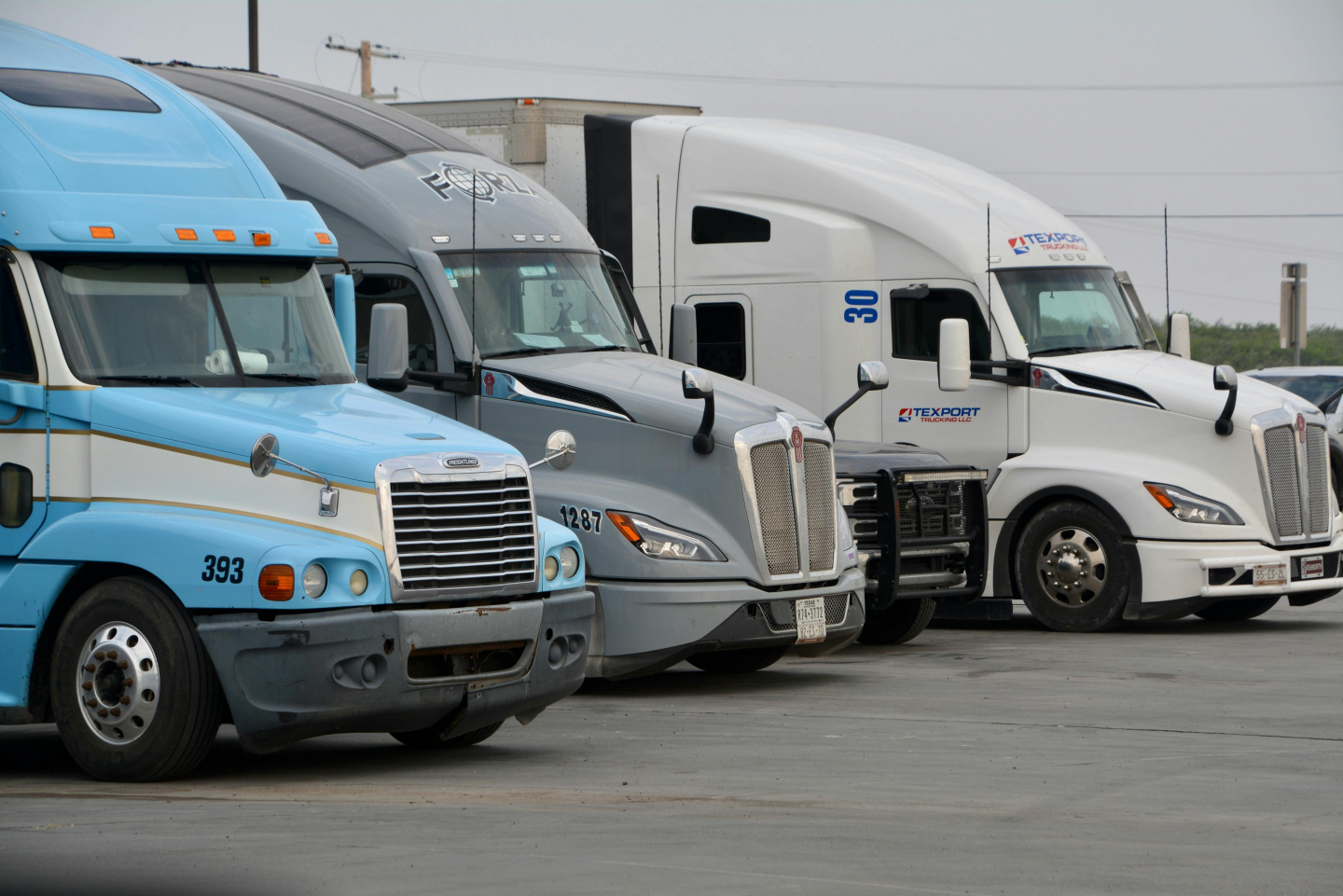
Most of the trucks in this part of the industry are owned by small companies that subcontract to the corporate giants — Amazon, FedEx, USPS — and a substantial share of those small companies are run, in Magill’s blunt phrase, by “gangsters from Serbia, Moldova, Uzbekistan, Kyrgyzstan.” The carriers are directed from overseas, often employ only co-ethnic foreign drivers, and “actively discriminate against American and Canadian truckers.” The federally mandated electronic logging devices, which were sold in 2017 as a tool for compliance with hours-of-service rules, can be remotely overridden from a Belgrade or Bishkek office when an exhausted, confused foreign-born driver runs out of legal hours. The insurance is provided by Progressive and Geico through instant-issue policies that, per Magill's reporting and others he cites, involve no vetting and no actuarial work: “Just give us your motor carrier number, the VINs for the truck, pay us, and we’ll give you insurance.” If the company accumulates too many crashes, it shuts down and reincorporates under a new name. The industry term for these outfits is “Chameleon Carriers” and the Federal Motor Carrier Safety Administration (FMCSA) appears to have neither the will nor the way to stop them.
To its credit, the Trump administration has tightened enforcement of an English-language proficiency regulation for drivers that has been on the books since 1937. Magill welcomes the move while doubting its effect. “Giving somebody an out-of-service ticket doesn’t necessarily mean they’re going to get out of the business,” he said. “There’s been plenty of documented cases of a driver being busted for not being able to speak English one day and getting the same ticket the next day in the same truck.” The order assumes the recipient can read it, will obey it, and works for a boss who cares whether he obeys it. “The only way to put these guys out of service is to seize the trucks and shut down the motor carrier registration numbers of the guys that own the trucks.”
Magill’s target isn’t individual drivers or even operators but rather the entire corrupt system that imports undertrained drivers because trained drivers would price themselves out of it. “If these guys came to America and were trained and as competent as me and spoke English, the whole system wouldn't work. Because then those guys would understand that they have some value and they can command more money. And then the gangsters they're working for would be out of luck. The whole point is to flood the market with people that don't know what they're doing.”
The aforementioned electronic logging devices prop up that system, too. Marketed as a safety measure, it produced, by the Owner-Operator Independent Drivers Association analysis of the four-year periods bracketing implementation, more than 15,000 additional injuries and 1,700 additional fatalities. Truckers are paid by the mile or by the load, never for the time they spend at loading docks (Correll’s MIT data shows long-haul drivers using only 6.5 of their allowed 11 daily hours behind the wheel because of unpaid detention time). Paper logs let experienced drivers massage the gap, but ELDs eliminated the flexibility while leaving the underlying piece-rate intact. The result was drivers racing the clock harder, and a system in which “everything in the entire system is set up to get in your way and slow you down. But you are only paid when the truck is moving.” Magill himself was fired for hacking an ELD on a Friday night so he could finish his run rather than sit for four additional hours on the Massachusetts Turnpike.
Back in March, the Teamsters published a piece on their Substack about deregulation and the driver shortage. Magill read it and found its many omissions galling. “Not once do they mention the migrants and trucking problem. Not once do they mention Biden. Not once do they mention that there's between 600 and 850,000 of these guys here. One third of the industry is now scab labor. And the Teamsters have never said anything about it. If Sean O'Brien expects non-union truckers to sign up to be Teamsters, and the Teamsters are saying nothing about the biggest problem in the industry right now because their Democrat paymasters might get mad they said something bad about immigration — I don't get it” He then compressed 45 years of labor history into one sentence: “Everybody is a capitalist until the price of labor is bid up.”
There are, it bears noting, a few good actors. In-N-Out Burger runs its own fleet of polished Peterbilt 379 tractors, owns 70% of its own real estate, pays its drivers and other employees top of market rates, and has never gone public. “When you see an In-N-Out Burger truck, you’re like, damn, that's a gorgeous truck,” says Magill. And Sam Walton, Magill argues, built Walmart on a similar foundation of quality trucking service: “Sam Walton wasn't necessarily a great retail mastermind. Sam Walton was good at trucking. He understood that if he didn't have his own trucks to deliver to the stores and he was relying on contractors, that was a problem.”
The innovators of tomorrow, alas, are far less benign: they see the next step as replacing as many of those imported, poorly-trained CDL-mill graduates as possible with human-free robot trucks. Aurora Innovation and its competitors — with backing from Democrats and plenty of Republicans, including J.D. Vance — are projecting roughly 25 to 40% cost reductions from replacing about 3.5 million American drivers with one remote support specialist per hundred trucks. A whistleblower from inside the AV industry, quoted by Magill in his book, explains what’s going on there: “The motoring public aren't seen as individuals with families to protect; they're seen as actors in the experiment.” Why bother raising wages to attract domestic workers or upskilling deer-in-the-headlights foreign drivers when you can do away with this form of monotonous wage labor altogether?
Magill himself was laid off from his last trucking job in 2023, and he is currently writing and doing construction work in Ithaca because most American carriers will not hire him back. His twenty-five years of experience, which include a four-continent driving record and twenty-one years without a speeding ticket, are now considered insufficient because the carriers treat experience as a wasting asset that depreciates after twenty-four months out of the cab. There is something appropriately terrible and stupid about the fact that the man best equipped in North America to write End of the Road is also someone the industry isn’t rushing to rehire.
For Pennsylvania readers, End of the Road offers an argument for taking your own tractor-trailer-plagued commute personally. Those traffic-snarling backups on the PA Turnpike and the insurance premiums creeping upward every year are visible to anyone paying attention. The body count along our interstates is harder to assemble into a single picture, though states like Texas at least post the daily fatality count on their major highways, as if state regulators are angling for a high score on a game of Donkey Kong. Magill's closing line, which we should all take to heart, could easily double as famous last words: Keep on truckin’ — while you still can.