

Aaron Rodgers' Real Last Season Is One Worth Watching
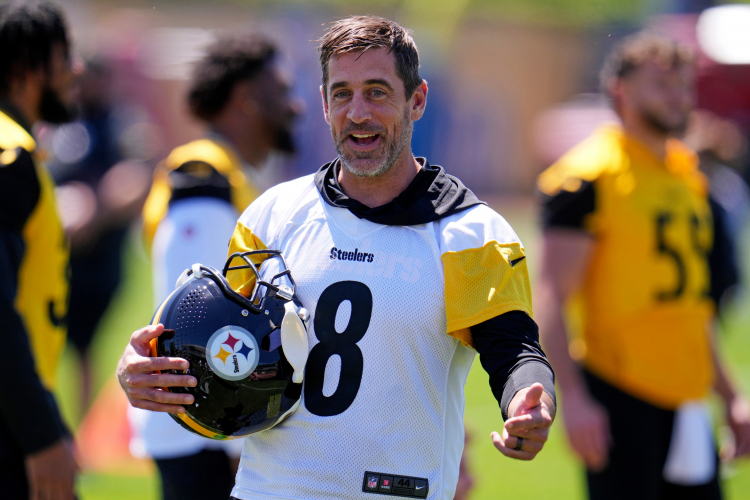
On a December afternoon at Ford Field, with the Steelers’ season hanging on every snap, the oldest player in the NFL hustled to the sideline and beat All-Pro Detroit linebacker Jack Campbell to the boundary by a step. Aaron Rodgers, 42, offered the 25-year-old a hand up, got it refused, and chided him on the way back to the huddle: slower than a 42-year-old. Pittsburgh held on 29-24, won its third straight, and seized the AFC North lead. It was the oldest trick in a weather-beaten book, twenty years of reading defenses distilled into knowing where the chalk was before the speedy young defensive star could get there.
That is the Rodgers worth paying middle-of-the-market dollars for, and earlier in May he confirmed there is one season of it left. He signed a one-year deal worth up to $25 million, reported for the voluntary spring work instead of dragging the call into June the way he did a year ago, and told reporters “this is it” with none of last year’s “pretty sure” hedging. He came back for one reason. The Steelers hired Mike McCarthy, the Pittsburgh native who coached him for more than a decade in Green Bay and won an entertaining Super Bowl XLV with him against this very franchise.
Last June, I wrote that the smart play was to enjoy the chaos and let the eccentric Rodgers either conjure up a brief playoff run or flame out and force the rebuild the organization kept avoiding. He managed to do both. The Steelers reached the playoffs, then lost 30-6 at home to Houston, the worst postseason defeat in team history, and long-suffering, long-succeeding coach Mike Tomlin resigned the next day after nineteen seasons without a losing record and nearly a decade without a playoff win. McCarthy, a heavyset, ruddy-faced man who is no spring chicken at 62, became the fourth Steelers head coach since 1969 and the oldest one the Rooney family has ever hired (this includes Pitt Panthers great Jock Sutherland, who died a year into a successful rebuilding project in 1948). But McCarthy’s return was fortuitous, because Rodgers likely thought that was the end of the road for him, too – until the coach who knew him better than anyone walked back through the door.
The skills, though diminished, are still there. Rodgers threw for 3,322 yards, 24 touchdowns and seven interceptions last year inside a restricted offense that asked the superhumanly-jacked DK Metcalf to be the only receiver a defense had to respect – which meant they had to respect nobody when Metcalf was suspended after striking a Detroit fan. So Omar Khan went and got him a second one, trading with Indianapolis for Michael Pittman Jr., a muscular, 6’4” second-generation possession receiver who announced at his introductory press conference that he intends to play bully ball in the AFC North.
The draft, full of risky picks high on potential, could take the franchise well past Rodgers. The Steelers spent their first pick on Max Iheanachor, an Arizona State tackle born in Nigeria who didn't play football until junior college, came up as a soccer player, and ran an extraordinary 4.91-second 40 at 321 pounds. They traded up for Iowa lineman Gennings Dunker, whose red-haired mullet went so viral at the combine that Rich Eisen called it the greatest in the event's history and the Kelce brothers spent an entire podcast segment on it (his weight room workouts are equally colorful). They then grabbed Dunker’s deceptively speedy Iowa teammate and star return man Kaden Wetjen and, in the seventh round, Eli Heidenreich, a Mount Lebanon kid whose combine performance compared favorably with Christian McCaffrey’s after a Navy career built on jet sweeps. The riskiest selection of all came at No. 76, where Pittsburgh used the pick it received from Dallas for swapping malcontent wide receiver George Pickens to take Penn State quarterback Drew Allar, a 6-foot-5 Ohioan with a cannon arm and an up-and-down college record. He joins Will Howard, last year's sixth-round, NCAA title-winning Ohio State rookie, in a quarterback school run by the elderly headmaster the Steelers hired specifically to develop one because the youth movement on the other side of the ball is getting old. All-Pro defensive tackle Cameron Heyward, whose running back dad Craig rumbled down the sidelines at Pitt during the 1980s, is 37, and future Hall of Fame linebacker T.J. Watt is on the wrong side of 30. To borrow a line allegedly said by Yankees catcher Yogi Berra, it’s getting late early out here in Pittsburgh.
One quarterbacking great who rode off into the sunset this way was Joe Montana, who grew up in Monongahela, twenty miles down the river, the western Pennsylvania kid (Ringgold High School) who served as San Francisco's golden-domed quarterback during four Super Bowl wins and then struggled through his final two seasons in Kansas City, 1993 and 1994, both of them playoff years, under Marty Schottenheimer, who was born in Canonsburg and played his college ball at Pitt. Montana even beat coach Bill Cowher’s resurgent Steelers in his first playoff game as a Chief before the run ended a game short of a Super Bowl. Now the picture flips as an aging but still-wisecracking “kid” from Chico, California who grew up idolizing Montana will watch his sun set in the Rust Belt under another Pittsburgh native, hopefully scraping out another playoff win or two before he goes ungently into that good night.
And a short playoff win is probably the best the Steelers can hope for, given how the deck is stacked against them. Most power rankings already have the team slotted in the bottom third of the league, the back half of the schedule is brutal, and Rodgers’ beat-up body won’t get more reliable in December. There will be ugly stretches, where pockets collapse and Rodgers’ legs can no longer get him to safety, but this kind of ugly was always part of the deal.
Setting that aside, the mere prospect of change, any kind of change, should excite Pittsburghers. After all, this is a franchise that retained Mike Tomlin nine years past his last playoff win because firing people is not the Steelers way. Then, for one thrilling offseason, it turned nearly the whole thing over at once. For the first time since Rodgers’ Packers ended what could’ve been a generational Steelers run in the Super Bowl, the franchise has chosen to discover what comes next instead of relying entirely on what’s left.