
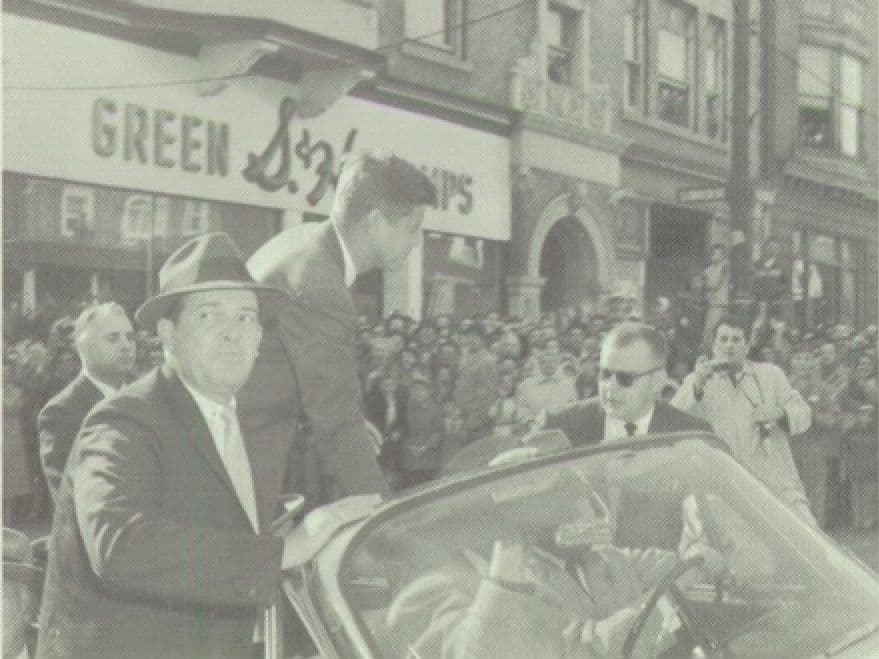
AMERICA AT 250: THE 1960S--Cultural Upheaval
Last updated 12:30 PM EDT • Read time: 6m
“… for time and the world do not stand still… and those who look only to the past or the present are certain to miss the future…” -President John F. Kennedy, June 25, 1963
Among the most tumultuous periods in our nation’s history, the 1960s collectively brought about enormous change in American society, in politics, in business, music, fashion, technology, social mores- in virtually every realm of human endeavor. With more than a half-century of hindsight, it is today easy to look back upon that time and simply say “Quite a lot happened.” Yet such words minimize the dramatic events which both shook and shaped our country, with Fidel Castro consolidating power 90 miles from our shores to start off the decade… and an American walking on the Moon to end it. In short, the 1960s were one of the most consequential periods of the last century, the repercussions of which continue to reverberate today.
In some ways, politics were at the forefront. “Out with the old… and in with the new” was epitomized by 70-year-old Dwight Eisenhower handing the reins of the nation over to 43-year-old John F. Kennedy, the youngest man ever elected President of the United States. Eisenhower’s steady hand at the wheel helped steer the country though both the Korean War and the many societal disruptions which rocked the mid-late 1950s. If the 1950s were a breeding ground for civil rights, the 1960s proved to be the crucible. Martin Luther King, Jr.’s “I Have a Dream” speech in 1963 set the tone for the rest of the period and helped lead the way forward on civil rights as laws changed and social practices evolved to give black Americans equal voting rights and recognition in a wide variety of settings. Kennedy’s youthful grace and acceptance of change helped this movement forward, until he was shot and killed in Dallas on November 22nd of that same year.
With Kennedy’s assassination came both shock and disillusionment with government. Why would a man so youthful, talented and eager to help move our nation forward be cut down in the prime of his life? Many were convinced that the killing was a well-orchestrated plan by insiders within the highest realms of government working behind the scenes with leaders of organized crime to rid the country of a man they both disliked for varying reasons. More than 60 years later, the definitive answer to this question remains elusive.
Kennedy’s assassination was still fresh in the minds of all Americans when on February 9, 1964, four young lads appeared on the Ed Sullivan Show with enticing smiles, capturing the hearts of viewers with a suite of songs that seem quaint today, including “I Want to Hold Your Hand.” The Beatles gave America a breath of fresh air and picked us all up when we were so very, very down following the loss of our President. Their superb singing and musicianship impressed the music world, starting a movement called “Beatlemania” which was part of the ‘British Invasion’ that changed the face of popular music forever. No longer would entertainers just sing a song- typically written by someone else- they were part of a musical group which wrote, arranged and deftly performed their own tunes with superb singing and playing abilities. Although the tone and pace of the new music was a shock to those who grew up in the Big Band era, it heralded a new movement of pop music which dramatically transformed the listening landscape.
Developments in science and medicine were no less transformative. Doctors performed the first human limb reattachment in 1962, the first liver and lung transplants in 1963, delivered the first vaccines for measles (1964), rubella (1966) and mumps (1967), along with the first portable defibrillator and first neonatal care units; the groundbreaking coronary artery bypass and human heart transplants were performed in 1967. Changes in technology were also impressive, with the first lasers, audio cassettes, the automatic teller machine (ATM), dynamic random-access memory (DRAM), the computer “mouse”, video games and the ARPANET- the grandfather of today’s Internet. In chemistry came products like Kevlar, now used in wide variety of applications including bullet-proof vests, as well as the first noble gas compounds and stable room temperature liquid crystals- the foundation for today’s LCD screens.
One comes away from a review of the 1960s with the feeling that it was the decade in which America, in some ways, lost its ‘innocence.’ Movies, personal lifestyles, widespread use of illicit drugs like marijuana, modes of dress, music and even marriages changed, with the divorce rate climbing sharply after California enacted the first “no-fault divorce” law, enabling people to part ways over what they considered irreconcilable differences. In the decades afterwards, divorces went from relatively rare to commonplace, effectively negating the “Til death do us part” bond agreed to for centuries and leading to the dissolution of millions of families. Added to this, the Vietnam War caused vehement disagreement and sometimes violent protests all around the nation, tearing households apart and assisting in creating a “counter-culture” dedicated to negating everything that society and their parents stood for. It seemed that America was breeding its own discontent… and the shocking social and cultural trends were simply the means of expressing it.
What can we take away from the 1960s? This author grew up in the late 1950s and 1960s, so the changes “hit home”, leaving a lasting impression. One- it seemed our society went from childhood to maturity in a few short years- far too quickly for us all to fully understand the impact of what was happening. Second- the huge shifts in personal lifestyles and morals, while enormously disruptive to families and society in general eventually led to a ‘pendulum swing back’ towards the middle, with some people who called themselves ‘hippies’ living in communes later becoming clean-cut workers who participated in “the system.” Many who ‘went wild’ in the late 1960s ‘found themselves’ in the following decades, getting married, starting families and working in respectable jobs. It took a while, but often meaningful change does just that. Perhaps we needed to see the pendulum swing to an extreme… before we realized where true center was.
Gene Pisasale is an historian, author and lecturer based in Kennett Square, Pennsylvania. His 12 books focus mostly on the history of the Chester County/mid-Atlantic region. Gene’s most recent work is “Sandy Flash and the Trail of History”, showcasing the fascinating people, places and events of this region over more than 300 years. His books are available on his website at www.GenePisasale.com and also on www.Amazon.com. Gene can be reached via e-mail at [email protected].
More From RealClear

Platner Says He Won't Be an 'a–hole' Like Fetterman in Senate
By Tara Suter, The HillBlame Pennsylvania for the Gerrymander Mania
By Guy Ciarrocchi, RealClearPA
What Chris Rabb's Win in Philly Means for Fetterman
By Sam Janesch, InquirerVoters Signal They're Done With MAGA Chaos
By Mark S. Singel, PennLive
Republicans: Pre-Canvassing Bill 'Lets Dead People Vote'
By J. Kramer, Center Square
Pennsylvania Today
Featuring the latest pennsylvania news
RCP Today
Top stories on RealClearPolitics
Investigations Today
Latest investigations news
Defense Morning Recon
Featuring the latest news