
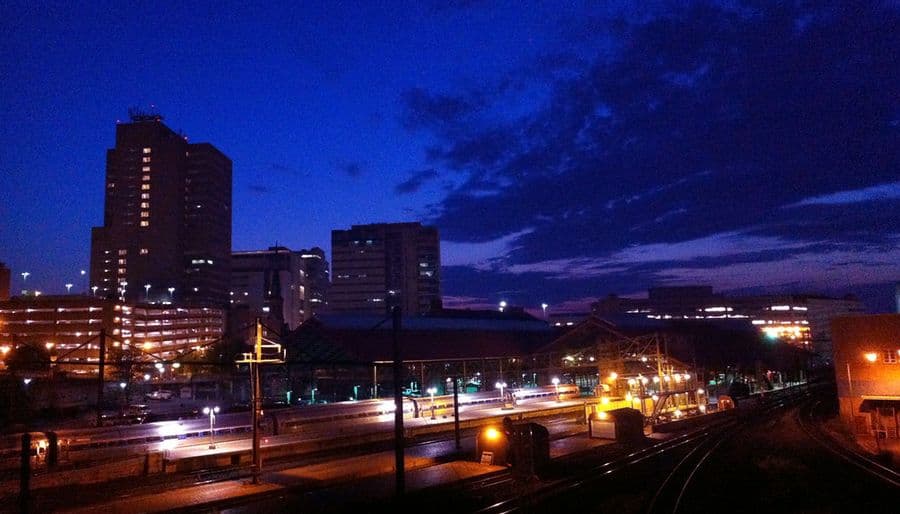
The $64 Million Harrisburg Question
Last updated 11:26 AM EDT • Read time: 9m
A few weeks before Gov. Josh Shapiro arrived in Harrisburg to make a splashy announcement of $64 million toward a revitalization plan for the capital city, local officials faced a far less photogenic task: finding $2.3 million to return to the state. The city had failed to finish a playground project at Reservoir Park before its grant deadline expired, despite multiple extensions. Indeed, in Pennsylvania’s capital, even free money apparently requires more administrative competence than we can reliably supply.
That’s why the mood in Harrisburg is flickering somewhere between cautiously optimistic and carefully pessimistic after Shapiro’s September 28 announcement of $64 million in public and private investment — including $22.7 million of state money —under the banner “Harrisburg Works for All of Us.” Given the city’s current moribund state, that slogan almost feels ironic — it barely works. It’s too bad the plan’s long-term success relies heavily on the two parties least equipped to deliver it: a corrupt, incompetent mayor in Wanda Williams and a do-nothing City Hall often at war with her.
First, the good news. On paper, there is plenty to like: a new downtown hotel, improvements to the criminally underutilized Susquehanna Riverfront, and funding to develop a master plan to revitalize City Island. There’s also vague talk of improving public safety technology and parking woes. But for nearly every nice bullet point in Shapiro’s Harrisburg agenda, there’s a caveat or an incomplete grade.
What no one will say is that this plan is a compensation package for the partial withdrawal of the state government. This is a company town, and that company is the Commonwealth of Pennsylvania. It’s by far the biggest landlord here, and it pays no property taxes. Harrisburg became a ghost town during Covid, and six years later, it still hasn’t fully returned to its pre-2020 self. Why? Despite a return-to-office mandate, many Commonwealth employees have stayed fully remote or work hybrid, and the old five-day lunch crowd is a thing of the past. Shapiro’s Space Optimization & Utilization Project (SOUP), released in 2025, reflects this new reality; it shrank the government’s office footprint in Harrisburg and beyond to cut costs. In the end, there was no reason to keep up the facade of big office spaces with fewer people.
The savings make sense on the state’s balance sheet. But what’s good for Pennsylvania taxpayers is bad for Harrisburg on the ground, and the scarcity of state workers has helped fuel the doom-loop effect. Walk downtown on a Monday or Tuesday morning, and you’ll find nearly as many homeless people shuffling through the streets near the green-domed Capitol building as state workers. Over the last three years, restaurants, pharmacies, and other needed retail have closed, and a stretch of Second Street resembles a post-apocalyptic wasteland, with trash in the streets and people sleeping in doorways of abandoned buildings. When pasta joint Pastorante closed in mid-2025, the owner cited declining business, neighborhood bar fights, the odor of marijuana everywhere, and a shop window shattered by gunfire. They moved to nearby Steelton, which isn’t exactly fleeing to a crime-free paradise.
Nearly half of the state’s funding ($11 million) in Shapiro’s “Harrisburg Works for All of Us” plan is earmarked to help developer Harristown Enterprises convert 333 Market Street — the tallest building in the city — into a proposed 130-room Courtyard by Marriott hotel. The tower, which was formerly the state Department of Education headquarters, was vacated earlier this year thanks to SOUP. There’s a certain circularity here: the state leaves a building, then subsidizes funding someone else to occupy it. Still, converting obsolete offices into somewhere people might want to stay is a reasonable response to a downtown that can’t count on the lunchtime sandwich economy. But the follow-up question is what they’ll encounter when they leave the hotel lobby.
What Harrisburg visitors won’t be able to enter anytime soon in nearby Midtown is half of the historic Broad Street Market, which first opened during the Civil War. Its fire-damaged brick building is both a beloved neighborhood institution and an increasingly expensive monument to Harrisburg’s faceplanting failures. At a September construction update, officials said completion was expected next summer — a full four years after the fire — with the rebuild now projected to cost $23.7 million, with much of the additional work involving a collapsed wall and the foundations and shoring needed to stabilize the building. The state’s $2.25 million contribution, included in Shapiro’s package, won’t even cover the increase in the project’s price tag. If you want a one-building summary of Harrisburg in the 2020s, here it is.
Unfortunately, the dysfunction extends well beyond the market. Wanda Williams, now in her second term, has managed to combine the petty entitlement of an old-fashioned machine politician with remarkably little evidence that she can operate the machine. Consider her use of a city-owned dumpster to clear out her home without paying the required fees, which led to a state ethics investigation and settlement. Even her repayment check arrived late.
Her personnel disputes are more consequential. Former public works director Nate Spriggs alleged that Williams retaliated against him after he refused to promote her son and raised concerns about favoritism. Williams denied the allegations, and the city admitted no wrongdoing, but taxpayers still paid the tab for a $150,000 settlement. More recent, finance director Robert Kennick said he was fired after opposing salary increases that he believed lacked sufficient justification. Then came the extraordinary spectacle of the administration’s own spokeswoman warning the city council about her cronyism and incompetence. This summer, communications director Mischelle Moyer lost her job after an investigation into an anonymous letter she wrote warning council that the parks department staff were “fumbling” $1.9 million and that “the Mayor has once again fast-tracked jobs showing favoritism over qualifications.” The city called it a false “diatribe.” A few weeks later, it mailed the Reservoir Park money back to the state. Council President Danielle Hill said it plainly: “The ball was dropped.” Oops!
City Council, meanwhile, has become the other combatant in a long-running municipal civil war. After council defunded several senior positions in Williams’ administration, including roles occupied by unconfirmed appointees, Williams sued to restore the salaries and lost. But the judge who upheld council’s authority also warned that leaving key jobs unfilled could have severe consequences for city government and urged both sides to negotiate. Residents were effectively paying lawyers to establish which officials had the authority to leave them without a functioning administration.
While the city council and the mayor battle in City Hall or court, basic needs go unmet. For instance, a July 4 storm knocked out power to thousands of Harrisburg residents. As a result, trees fell, utility lines came down, and older residents and people with medical needs were left in apartments without air conditioning during dangerous summer heat. Yet for much of the next day, residents received no clear, timely emergency bulletin explaining what help was available, where cooling centers were open, who to call, or what the city was doing to assist vulnerable residents.
Then there’s the public safety problem. Crime remains a blight. Homicides fell to 14 last year from 22, which is real progress, but assaults rose, and roughly a quarter of the police bureau’s sworn positions sit vacant. The same week of Shapiro’s announcement, there was a drive-by shooting a block from my Midtown home, and my friends were interviewed about shell casings outside their house. Nobody died, and I saw no news coverage. Over the past year and a half, I’ve personally had my e-bike and my car stolen. When I sought help, I was told to file a report online and that staffing shortages left police with little capacity for nonviolent property crime. The state’s answer is a promise to “partner with” city police “to identify funding to modernize and expand use of technology.” No dollar figure is attached, and it feels woefully undercooked, but perhaps that’s because it’s the city’s responsibility.
A pattern emerges in “Harrisburg Works for All of Us” in that much of it awkwardly sidesteps the mayor and city council. The Harrisburg Regional Chamber & CREDC and the Pennsylvania Downtown Center led the plan, and most of the funding is earmarked for developers or non-profits. It’s as if the state and the business class have quietly concluded that the fastest route to a better downtown runs around the Rev. Dr. Martin Luther King Jr. City Government Center, and they are probably right.
Part of what’s embarrassing for the city is that it’s had its own redevelopment plan gathering dust. In November 2021, after seven years of drafting, City Council approved a 246-page comprehensive plan, the city’s first since 1974. It imagined a mixed-use development beside the Broad Street Market, refreshment kiosks in Riverfront Park, and a grand downtown gateway. Five years on, almost everything in the plan remains a rendering, and about the only person talking about it — Basir Vincent — lost his City Council bid last year.
I desperately want this plan to work. I live here, and I’d prefer not to spend the next few years accumulating material for another column like this one. Harrisburg has a beautiful riverfront, handsome, walkable neighborhoods, and small-business owners and entrepreneurs like nightlife king Justin Browning, whose persistence sometimes borders on a cry for help. There’s a city worth saving here, and Shapiro deserves credit for putting money towards saving it.
But his check won’t staff a police shift, process a building permit, or supervise the market’s reconstruction. Before Harrisburg gets too carried away imagining its next renaissance, it might want to show it can finish building a playground.
Ryan Zickgraf is a writer based in Harrisburg. He is a columnist at UnHerd. Follow him on X at @ryan_zickgraf.

Platner Says He Won't Be an 'a–hole' Like Fetterman in Senate
By Tara Suter, The HillBlame Pennsylvania for the Gerrymander Mania
By Guy Ciarrocchi, RealClearPA
What Chris Rabb's Win in Philly Means for Fetterman
By Sam Janesch, InquirerVoters Signal They're Done With MAGA Chaos
By Mark S. Singel, PennLive
Republicans: Pre-Canvassing Bill 'Lets Dead People Vote'
By J. Kramer, Center Square
Pennsylvania Today
Featuring the latest pennsylvania news
RCP Today
Top stories on RealClearPolitics
Investigations Today
Latest investigations news
Defense Morning Recon
Featuring the latest news