
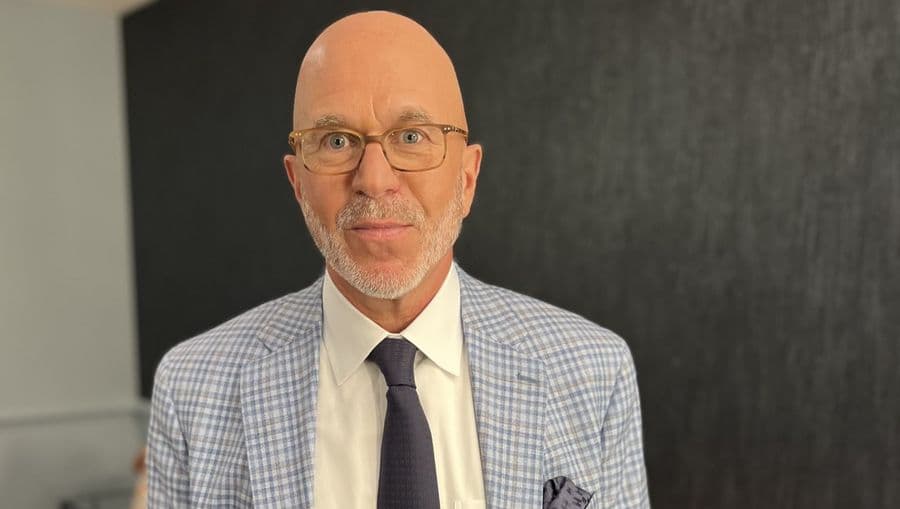
In Conversation with Michael Smerconish
The Philly-bred tv and radio host talks about the midterms, PA politics, and what happened at CNN
Last updated 11:01 AM EDT • Read time: 36m
When you interview the best interviewer you know, you should probably be graded on a curve. I have known Michael Smerconish since the late ‘80s (when we were both young tykes in our ‘20s and both of us had hair), and I have never once seen him off his game, not even for a moment. Not on the air, in the 15 hours (15 hours!) of live Sirius radio he does each week or his live Saturday morning show on CNN that is Must-See-TV for pretty much anyone who cares about the world.
Not off the air, either. He is always so impeccably groomed, so beautifully pulled together (damn, I forgot to ask him where he gets his gorgeous suits), that it annoys me sometimes. So I was somewhat relieved that he was dressed casually for our Zoom call. Well, casually for Michael. Even in a sweatshirt, he manages to look as though a great deal of thought went into it, and I’ll bet it did.
He came to me live from his airy lair, aka home office, on the Main Line. To talk about the midterms, how much he misses the days of Frank Rizzo, the greatness of men like Tom Ridge and John Heinz, how people used to be so civilized, and that weird anal thing he does with his newspapers.
LDP: Michael, how did they let Jalen Hurts play?
MS: What a story, huh? Up 36 hours before the game in London? How can that be?
LDP: They did not let him sleep because apparently it was too dangerous for him with a blood clot to sleep.
MS: Well, how did he fly home then? Was the first thing I wondered. Right? Don’t they say you can’t fly with a blood clot?
LDP: But you can play football. (laughs) So Michael, you set this up yourself. Don’t do you have a secretary?
MS: No.
LDP: Alright, this blows my mind, because the first thing I want to ask you about is the mystery with you always. How do you do everything you do?
MS: I don't know. I was just thinking about how I was looking forward to just spending time with you today and relaxing, 'cause I have to turn my phone on silent, and I'm actually just looking forward to sitting still. Smoking a cigar. Answering whatever you want me to, because it's a break for me. Because my day—I was out of bed before 4:15 today, and it's a lot. I got a lot of things going on. It's true.
LDP: What did you do since 4:15?
MS: So, I needed to make sure, as I always do, that I read in early, because I've read in before I went to bed, but I have to read in to put my newsletter to bed. And I do that by five. So I've got to take one more look at the landscape and decide what has broken overnight that I want to include, and then I hand off to the newsletter editor and she handles dispatch, but I really do make the selections of the links myself, because that's the whole premise. The whole premise is, you know, I'm providing you media balance, and I'm selecting from the left and the right.
(His daily newsletter, which has 150,000 subscribers, is really well done.)
MS: And then I was in my studio by 6. The show was booked, but I wanted to work on my opening commentary and reread about the guests and, you know, I'm the sort who does all that preparation so that when the microphone is hot, the hard part of the job is over.
LDP: But you even do the Newsletter yourself?
MS: Yes. I don't do the dispatch, but yeah, that content is selected by me, and the note is written by me, and the poll question, which might seem like it's an easy thing, is not, that's determined by me. And then, I deliver that show from 9 to noon live. And then we had a staff call because we do have a large group of people because I'm doing other projects and everybody's involved. And then my life begins! So, I got dry cleaning. I picked up my MRI at the hospital of my shoulder. Then I went to a diner solo, sat at the counter, ate egg salad, and a cup of chicken noodle soup.
LDP: Egg salad!
MS: It's just like all, you know, the stuff of life. Mom's birthday is Sunday. I know I gotta get that card in the mail today to ensure it gets there on time. So I went to get the card and then I went to the mail and then I worked out, and now here I am. And when I'm finished chatting with you, this is really what I do for a living. (Holds up a book.) Then I will read this book, Against Convenience. It'll probably be the 4th book that I will read this week. I love this. I had a great author on today who wrote a book that totally captivated me about a subject that's really not political, and, you know, I'm just reading and making shit happen for tomorrow's show. That's it. Whatever tomorrow's show might be.
LDP: I don't think most people realize that most—No, no, ALL-- radio and TV hosts have producers who tell them what was interesting in the book. You fucking read every book.
MS: I do. Yeah. I always laughed when Larry Kane (local anchorman) would say—and I love Larry Kane—but I would laugh when he would say, “Well, I want to be on the same, level as my audience. They haven't read the book, so why would I?” I thought that was hysterical, you know? That was his line.
LDP: How much sleep do you need?
MS: Not much. Um, not much. Probably, you know, five and a half hours is what I require. I wish I could sleep longer, but I can't. You know, what happened is, I did morning drive for nine years. And that was a 2:45 wake up, and I just never shook it. It's not like I stopped doing mornings, and then I can sleep till 11. The only day that I don't set an alarm is Sunday, and I can't make it past 6 a.m.
LDP: And you’ve always been hyper-organized. Do you still do that weird thing with the newspaper?
MS: If you mean, do I write notes on my copy?
LDP: Nope, that’s not it.
MS: Okay, well, wait, wait. Hold it. I’ve got a lot of idiosyncrasies, but relative to the newspaper, um, I have a thing where I need a fresh copy.
The only paper I touch these days is The New York Times, but I go to great lengths to actually get that paper. I need to touch it. I enjoy that process.
LDP: Right.
MS: I will happily buy you your newspaper. Like a 100 years ago, if we were a family and we went to the shore and I would go to Wawa early, I’d happily bring everybody a paper. Because I just need to experience opening my own and reading it, and somehow, like, if you read the sports section before me, I felt like it had been defiled. (laughs) Is that what you were thinking of?
LDP: That’s the thing.
MS: The only paper I touch these days is The (New York) Times, but I go to great lengths to actually get that paper. Again, all I do all day long is read, but when it comes to The Times, I need to touch it. I enjoy that process. And I tear shit out, and I mark it up, and I keep a stack for the things I want to read, for me. Like, I’m not talking about these on the show, but there’s always a stack of the ‘me time’ things, and it gets bigger and bigger and bigger. And then I have a long plane ride and I finally read that stuff.
LDP: Do you ever have time to read a book just for you?
MS: No, I really don’t. I mean, Woody Allen's memoir is on my table next to my chair where I read, and it’s been there for more than a year. By the way, I probably shouldn’t say that I look forward to reading Woody Allen’s memoir, but so be it.
LDP: But it’s amazing what—
MS: No, Lisa, let’s not give me too much credit. This is what I do for a living. I read for a living, so I know what to speak, and probably a large part of it is driven by a fear of embarrassment that I don’t want to be on air and involved in a conversation I know nothing about. That’s the truth.
LDP: But you know that nobody else does that.
MS: Well, they have it easier than I do, because if you go on air and all you do is read the talking points? You know what the talking points are! Oh, my God, to go on air and to simply bash Trump or suck up to Trump. How easy that must be. You know what all those arguments are. Right? It requires nothing.
LDP: You're right. We’ll get to the centrist thing. But Michael, first let’s go back to 1991. Which was a big year for you. And a really big year for Pennsylvania politics. Within three months, you have [former Philadelphia Mayor Frank] Rizzo dropping dead. And [former U.S. Sen. John] Heinz dying in a plane crash. What a seismic shift in Pennsylvania politics. What was it like from your vantage point?
MS: Well, top of mind, for me, is that I had been, for a year of my life, I haven’t told these stories for a while but I’d been joined at the hip with Mayor Rizzo for the entirety of 1987. 365 days a year in that town car, you know, with [the late Philadelphia lawyer and power broker] Marty Weinberg behind the driver, Steve Silvetta.
LDP: Rest his soul. [Marty, who recently died.]
MS: Yeah, I know. Shame. (We have a moment.) And, of course, I got the short end of the stick sitting behind Rizzo because he was so big, he would push the seat back, and Weinberg knew that. So the seat that I got was that one. (Laughs.) So, you know, we (he and Rizzo) had this really unique relationship, but it didn’t end well. Not long after '87 headed into the '88 campaign. Long story, but we went a period of a few years without speaking. Literally just not speaking. And then, shortly before he died, when I had been appointed regional administrator at HUD, he reached out to me and we had a lunch and a dinner. And then came the day that he passed. I was at HUD, initial days on the job, and I get a phone message from, uh, I think it was Jody Della Barba. The mayor wants to see you. And I walked down Walnut Street to 1528 Walnut Street and went up on the elevator and there was sort of a hullabaloo, something was wrong. You remember Bobby Cutler, The Cut?
LDP: Oh yeah. Piece of work.
MS: Cut comes out and says to me, uh, he’s not gonna make it or he’s gone. I don’t remember which. I mean, the bottom line is, Rizzo passes. I was there when he passed and I was grateful that we’d had the opportunity to speak again before he died.
LDP: Yeah, really. Because weren't you his pen pal when you were a kid?
MS: Oh, Jesus, we’re gonna tell all these stories too?
LDP: We are. How did that happen?
MS: You know, growing up, in my household, he was a guy who you had to revere. It could have been like an Eastern European thing. You know, Rizzo [being] Italian. My dad, part Ukrainian, part Italian, my mother, Yugoslavian, today we would say Montenegrin. And he was just a guy who was admired in our house. And it is true that when I was in high school, I wrote to him, and he was at the end of his first term, and he wrote back. And then there came a day when, right before I went off to college, a mutual friend took me to his house for a breakfast that lasted four hours. I have the picture that was taken that day in the kitchen on Crefeld Street with, you know, Pete the parrot in the background. It's kind of hysterical.
LDP: How old were you?
MS: That was me at age 18, a newly-minted Republican voter. And now I am going off to school at Lehigh. And we maintain this relationship long distance. Rizzo runs against Wilson Goode in ’80 – oh, fuck me – in ’83, while I’m at Lehigh, he runs and loses as a Democrat. This is actually an important part of the story. And so in 1986, in the general election, I played a significant role. Now I’m in law school at Penn. And I played a significant role for Arlen Specter, running for [U.S. Sen.] reelection against Bob Edgar. And Rizzo changes parties, and now is running as a Republican. Speaking of Marty Weinberg, rest in peace, you know, Marty used to walk around with this little note card in his pocket showing anybody who he was trying to win over that if only the 225,000 Republicans had been able to weigh in in the ‘83 race against Wilson Goode, Rizzo would have beaten him. Which made a very convincing argument. So Rizzo now becomes a Republican in the ‘87 race, but he doesn't know the Republican apparatus. I am standing there having run the street organization for Arlen Specter in Philadelphia in '86, and I'm a guy he knows from our pen pal relationship. The title that they gave me was Political Director. I don't want to overstate it. Marty ran the campaign, but my responsibility was to work with all the ward leaders. And that was the year that we were inseparable. And I was still in law school at Penn.
LDP: Jesus. So you get the HUD appointment a few months before Rizzo dies in ’91, right?
MS: Correct.
LDP: I remember the night you got it. Philly Mag was having some party at Rock Lobster, and you came in and said—
MS: Oh, boy.
LDP: You said, “I have great news!” The president had just called you. And it was huge. You were only 29.
MS: No, no, no. Jack Kemp had just called me. Bush was president. Papa Bush. And I had worked for him as an advance man. By the way, you want to talk about coming full circle? I just was invited and joined the board of Points of Light, which is the charitable foundation founded by Papa Bush. So it’s like a nice way to give back and be involved. You know, he was my guy, Bush 41.
LDP: So you’re 29, and tell me the accurate way to say this. Were you the youngest HUD appointee? The youngest cabinet appointee? I remember you were the youngest something.
MS: I don’t know. I was a regional administrator for HUD. Jack Kemp was my boss. It meant that I had responsibility for all federal housing in five states and Washington, D.C. Pennsylvania, Delaware, Maryland, Virginia, West Virginia. I hope I’m not leaving something out, and D.C. And if you really, really want to go down memory lane, Billy Meehan, who was still the Republican chairman, had opposed me getting that job. So for me to get it over the objection of the Philadelphia GOP chair, that was the big win. He didn’t want me to have it.
LDP: Okay, so 3 months later, Heinz dies. How different would our world be if he lived? Would he have beaten Clinton in ‘96?
MS: I don't know. I don’t know. Entirely possible. Charismatic, handsome guy. All I know is that is in 2026, the John Heinzes and Arlen Specters and Dick Thornburghs, if you want to think Pennsylvania, couldn't win a nomination in this incarnation of the Republican Party. Things have changed too much.
LDP: It's that bad?
MS: Well, it’s that different.
LDP: See, you really are fair. I think it's gonna be generations before – I don't think I will live to see this country normal again.
MS: Well, the extremes are calling the shots on the left and the right. That’s what worries me the most.
LDP: And from your point of view as a media person, I'm guessing, and I may be wrong, that as you became more centrist, it was not at a time where that was necessarily the right career move.
MS: Oh, my God--It was potentially a professional death sentence.
LDP: Why'd you do it?
MS: I just sort of had enough. Every one of these is a long story, but I had not voted for any Democrats for president. I voted for Democrats, but never for president, and I’d been active. I turned 18 in 1980, and I was totally on board with the Reagan-Bush version of the Republican Party. And then things changed. And the breakpoint for me is that I ended up voting for Barack Obama in 2008.
By '08, I’d had enough, but I stayed a Republican until I was at the DMV in 2010.
LDP: I remember.
MS: I had a real decision on my hands as to whether I should publicly share that. And when I did, and I did it in a 5,000-word Salon essay, and on air, I was very careful not to tell people, this is what you need to do. But I felt like I owed it to the audience to say, here’s what I’m doing and why. And the why was because I was so frustrated now by the lack of success of the Bush administration, which I’d supported, to go kill bin Laden. To go. Kill. Bin Laden. And there was this Pentagon trip that I took in 2004 or 2005, where the Pentagon put me on a military transport with two dozen other citizens, and took us to Kuwait, and the United Arab Emirates – all of these Middle Eastern countries in the span of one week – here they wanted to showcase how they were fighting the war on terror. And everywhere we would go, I would ask questions about bin Laden, and they would look at me like somehow I was raising the Voldemort. But I was just frustrated that it seemed like we’d taken our eye off the ball as to why the war on terror had begun. And Senator Obama came on my radio show, and spoke on that subject, and was my guest several times over. Always, we would talk about that, among other things. And he said to me that he’d go after bin Laden, even if he were found hiding in Pakistan, which ended up being prescient. And he was criticized for that. And of course, that’s how that story ended. But anyway, by '08, I’d had enough, but I stayed a Republican until I was at the DMV in 2010. And they have a pro forma question where they say, ‘Are you registered to vote?’ Yes. ‘Would you like to change your registration?’ I'm like, you know, I think I would. And that’s when I became a non-party affiliate, which is what they call them in Pennsylvania. And you know that I’m the lead plaintiff in this litigation trying to open Pennsylvania’s primary system.
LDP: Yeah, oh, God, I hope you’re successful. So when McCain picked Palin, how did you feel about the Republican Party then?
MS: Okay, honest answer is, I was in the [RNC convention] hall in Minneapolis St. Paul. And I really had no idea who the hell she was.
LDP: No one did. Including McCain.
MS: And she came out... I mean, I could, of course, just say to you, oh, I thought it was a terrible pick. But, the honest answer is that that night, if my memory is accurate, I remember leaving my seat and bumping into David L. Cohen, and telling him that the Republican Party picked the wrong candidate, meaning I was so impressed with the hockey mom speech that she delivered that night, which was before the wheels came off the bus, that I thought, ‘Holy shit, this woman is amazing.’ And then, of course, that story ‘evolved,’ we’ll say.
LDP: I had the same reaction.
MS: Senator McCain, I have tremendous respect for him. I know that he was disappointed in me. I had hosted him on several occasions for live events, with radio listeners, and I think he’s a wonderful guy, and I quote him in the speech that I deliver around the country about polarization because of something that he said in his final Senate address.
LDP: Which was?
MS: He said, “Stop listening to the loud mouths on radio and television. Our incapacity is their livelihood.” Truer words never spoken.
LDP: I was with you on Sarah. At the beginning. I was in Kuwait, actually.
MS: Wow.
L: Long story. But I was in this hotel room, and I said, ‘Fuck, this woman has it.’ The whole Lipstick on a Pig speech.
MS: Absolutely!
LDP: And then, as she became Sarah Palin, I was angry at McCain. Like, how could you have not vetted her?
MS: Right. And the two who would have been stunning choices were both rejected, apparently, because McCain was talked out of it, based on abortion. And I’m talking about Tom Ridge and Joe Lieberman.
LDP: Yes. And Ridge – when you talk about good men in Pennsylvania politics…
MS: Oh! Oh, my God. Yes. I mean, we have such a proud tradition of individuals who've represented this state. And all you have to do is look at that sort of gallery and realize that they could never today …
LDP: Who do you most admire today? On both sides.
MS: Joe Manchin.
LDP: Why?
MS: I've come to know him well, consider him a friend, and I think if we just had three or four Manchins in the Senate, the concentration of power would be in the hands of those individuals.
LDP: Interesting. Michael, what do you think of Mamdani?
MS: I think that he's uh … I think that the statement that he delivered, on 10/7, was tone deaf and horrible. Just at the point when I was starting to think, maybe he doesn’t believe some of the things that he ran on, then he delivers this statement, which was all about Hamas and showed no sympathy about Israel. Big mistake. And I think the Eat the Rich speech that he delivered outside the apartment of Ken Griffin was terrible. I admire his communication skills. Guy’s great on his feet. You know, really, really good. But I have a lot of misgivings. We’ll see.
I have my doubts as to whether you can sell Democratic socialism writ large in this country. They need a Frank Luntz to come in and give it a new name.
LDP: Do you get why he has such support?
MS: Yeah, I think I do. I mean, I have to say, very few people voted in that election. Yes, it’s New York City. But I think we tend to overstate some of the significance of that. I have my doubts as to whether you can sell Democratic socialism writ large in this country. They need, like, Frank Luntz to come in and give it a new name.
LDP: Definitely.
MS: Because if you explain some of the elements of it to people, I think you can sell it, but you can’t sell anything with the word socialism at this stage in this country. Now, I’m also knowledgeable about the data, which says that among young Americans, particularly young Democrats, they look more favorably upon socialism than capitalism, and they’re gonna vote for the next 50 years. So, you know, maybe in time, I'm wrong, but I'm not wrong today.
LDP: Could Barack Obama win today?
MS: If he got nominated, he could.
LDP: Could he get nominated today?
MS: I have my doubts.
LDP: Me, too.
MS: Because the loudest voices are controlling the nomination process. It’s gonna be very interesting to see who really runs and what the lanes are that they emerge in. I’ll give you another example on the Republican side of the aisle. Marco Rubio is a far more electable Republican than JD Vance. But could Rubio win an endorsement, a nomination I should say, in this version of the Republican Party, this MAGA version? No. Not if he’s running against Vance.
Give me a Specter-Heinz-Thornburgh-Ridge kind of person. Rubio's cut from that cloth. If that was still the GOP today, I'd probably still be in it.
LDP: Yeah, what’s gonna happen with that?
MS: I’m not convinced that Trump appoints – anoints, I should say – J.D. Vance. Because that would be too easy, and that’s not Trump’s style. Trump likes infighting. He wants The Apprentice. I know people disagree with this, but I just can't see that it all plays out and he says, ‘JD's my guy,’ and then it's Vance. That's not the playbook for Trump.
LDP: Who would be the better president?
MS: As between the two of them? Rubio. But that's, you know—
LDP: Doesn’t matter?
MS: That’s the old school Pennsylvania, you know, give me a Specter-Heinz-Thornburgh-Ridge kind of person. Rubio's cut from that cloth. If that was still the GOP today, I'd probably still be in it.
LDP: If you were choosing the nominee for the Democratic Party, who would it be for ‘28?
MS: Well, don't make me play favorites. How about if I answer this question – because this will surprise you – who is the most electable Democrat among the field, if they got nominated? It’s a totally different question as to whether they can be nominated. Rahm Emanuel. Smart. Fighter. Sensible. I admire the way he’s approaching this now. He’s out there listening, he’s speaking, he’s releasing for the benefit of anybody who will take the time to read them, serious papers, delivered a serious speech about Israel, in Israel, has had a lot to say about education. He’s impressed me with the way that he’s gone about this.
LDP: Who will be the first of the field as we see it now—
MS: To announce?
LDP: No, to crash and burn.
MS: Oh. I don't know which of them is really going to run. I have my doubts as to whether Harris runs.
LDP: I don’t think so.
MS: And I think that Newsom was kind of smart in saying, ‘Well, I'm not gonna get in it if she gets in it.’ Which is probably a true answer, but I think he's trying to force her hand and make her decide she's not running because that race is not big enough for the two of them. And I think that was his effort to kind of dispense with Harris running. Just my theory.
LDP: I think that Dougie doesn’t want her to run thing was done completely to give her a reason to not run.
MS: Could be. Yeah. ‘Cause why else would that get out? Right?
LDP: What’s gonna happen in the midterms?
MS: C’mon. I mean, that's the easy stuff, right?
LDP: You think?
MS: The only question is whether Democrats take the Senate as well as the House. I think it’s gonna be everything that everybody thinks it’s going to be.
LDP: I don't.
MS: Really?
LDP: Yeah. I’m one of these scared people ever since, you know, Hillary.
MS: Trump could be elected again. If Trump were on the ballot, if he were permitted to run in 2028, despite everything that is taking place around us right now, he could be elected. If he were permitted, he could be elected again. Because his approval rating may be horrific right now, but in the end, you can’t beat somebody with nobody. So you tell me who is the person who could run against him. But what I think is that when Trump is on the ballot, Trump's people come out. When Trump is not on the ballot, his people don’t come out. That’s why he delivers that line and says, act like I’m on the ballot. I’ll tell you who will come out. Every one of those people who attended a No Kings rally. Because people are pissed. And passion is high. And gone are the days when elections in this country are about persuasion. They’re about motivation.
LDP: Why do you have gold handcuffs on your wall?
MS: (Laughs) So, those are the handcuffs that were on [“Unicorn Killer”] Ira Einhorn, when he was extradited from France.
LDP: Get out. How’d you get them?
MS: I represented the marshal – who escorted him home. And he gave them to me as a gift. I’m probably the only nut you know who would want them hanging in his office.
LDP: You’d be surprised.
MS: Hey, I could take you into my gym, which is 20 feet away and I could show you a plaque that the Boys Club of Buffalo presented to O.J. Simpson.
LDP: Let’s go.
MS: Well, I have that, too, is what I'm saying. And why do I have it? Because it was taken from him when his property was seized to pay the Goldman family. And I just think that's, like, an awesome embrace of our civil justice system.
LDP: I know for a while, Michael, you wanted to hold elected office.
MS: Yep.
LDP: Why didn’t you?
MS: Well, I lost an election when I was 23.
LDP: But it was very close, wasn’t it?
MS: Yeah and I was in law school at the time, and I have zero regrets. It was a wonderful experience.
LDP: And then that was it?
MS: No, I thought about other things, but it just never... The moon and the stars just never lined up for me personally. Not even electorally, but just things on my plate and responsibilities, and it just didn’t work out.
LDP: But it's not a regret?
MS: No. (So it tracks.) I've convinced myself that I have a fair degree of influence doing what I’m doing, and I’m on a mission to try and restore civility, and to prove that you don’t need to be doctrinaire, and still to have success in what I’m doing. That’s what I’m all about.
LDP: Go back to becoming a centrist and how it was not the best career move at the time. You did it because you felt strongly about it?
MS: Well, I felt strongly about – it really begins with the war on terror. And me believing that we lost sight of killing the people who killed 3,000 Americans. As odd as it sounds, that was the breakpoint for me with the GOP. When George W. Bush was running for re-election, his final rally was in a Bucks County cornfield. This was the ‘04 election. And 20,000 people present, and I was the MC. So I was still on the train, you know? But I just became disenchanted with the fact that we were now in Iraq. Nobody was talking about bin Laden and al-Zawahiri. And that was really an important event in my life, even though I didn’t lose anybody in my immediate circle. For me, beyond family milestones, that’s the seminal end of my life. I wrote a couple of books, for which I did not take a dime, on those issues.
LDP: Talk to me about your time at Jim Beasley’s firm. (Huge litigator in Philly.) Because when I look back on that, I think that was really smart of you. You made some money. It was probably the right thing at the right time, right?
MS: Oh, Lisa, you know, that John Lennon quote is my favorite. “Life is what happens to you when you’re busy making other plans.”
LDP: Yes.
MS: That was not anticipated. Do you know how I got to Beasley?
I went to Beasley to sue Steve Lopez of the Philadelphia Inquirer.
LDP: Get out.
MS: Yeah, when I was at HUD.
LDP: What did Lopez write?
MS: That I was dishonest. And I went to Jim to take that case, and he accepted it. And we were working up the complaint, as the election was drawing near, so, this was 1992. And Beasley knew that I was an appointee of the administration. And he said, ‘What are you gonna do when your guy loses?’ Meaning Papa Bush. And I said, ‘Well, he's not gonna lose.’ To Clinton. (Laughs.) And so, he lost, and that job, even though Mayor Rendell wrote a letter to the incoming HUD secretary, Henry Cisneros, and said, ‘Could you please keep Smerconish?’
LDP: Really?
MS: Yeah. But I knew that that was not going to be long term. And so, Beasley hired me, and now it's time to file the complaint, he said to me, ‘If you want me to file the complaint against Lopez, I'll do it.’ He said, ‘But you walk down Walnut Street, thinking that everybody is talking about the (column) that he wrote about you’. This is at a time when Lopez had a lot of cachet on Sundays. And he said, ‘But nobody remembers it. You're the only one who remembers it. So if you want me to file it, I'll file it, but if you want to just start fresh, practice law here, we can do that.’
LDP: Why couldn’t you do both?
MS: I don't know, I guess it represented a new chapter of my life. I’m not looking back at where I've been. I'm looking forward and trying to establish my bona fides as a lawyer, not as the HUD guy.
LDP: Boy, Rendell. How would his career have been different if Rizzo lived?
MS: You mean in that ’91 campaign? That would have been one for the ages.
LDP: I’m kinda sad that we missed that. (Laughs) You’re still loving your Saturday CNN show, right?
MS: Uhhh. Yeah.
LDP: That’s not as full-throated as I expected.
MS: It's a lot of work. It is a lot of work. I write those commentaries myself, and more goes into it than I think people would recognize. But I appreciate the platform. They’ve been good to me, by and large.
LDP: How are your ratings?
MS: I mean, they’re okay. I'll say it to you this way. Normally, in terms of Saturdays, the show draws a higher audience, a larger audience, than any other show on Saturdays. When Bill Maher’s show plays at 8:00 at night, then that title belongs to him. So everything is relative.
LDP: You know what I think about you and CNN? I think they don’t use you as well as they should. I’m actually angry that you have never been a presidential debate moderator. Just my thing. I think it’s so obvious that you would be a great debate moderator. Has that ever been suggested? Would you want to do that? You’re awfully quiet.
MS: Yeah that’s the sort of thing that I would be interested in. Sure.
LDP: And I didn’t understand why you didn't get the 9 p.m. slot when Chris Cuomo imploded.
MS: Well, I actually did, because when he imploded, the first person Jeff Zucker put in that chair was me. And for the three weeks thereafter. And then, Jeff was gone.
LDP: Right. And then Chris came in. And he was a fan of yours. Or not?
MS: Chris Licht? Yes, he was. He offered it to me.
LDP: Why didn’t you take it?
MS: Initially, I said no because of my radio responsibilities. And then he came back to me, and he turned my head with the offer. In order for me to take the job, it required that I scale down my work at SiriusXM. So, I went to SiriusXM. I needed the permission of [President] Scott Greenstein, who’s always been good to me, to allow me to reduce my workload and take on a prime time television opportunity. And there was a delay because Scott was in Europe, and I was advised this is not a request that should be made when he’s overseas. So, he came back. And the first day that he came back, he greenlit my opportunity to do that. I went back to Licht and said, I'll do it.
LDP: And then Licht was no more?
MS: The following morning, David Zaslov called Chris Licht and asked to take a walk in Central Park. Where he was fired.
LDP: Wow.
MS: And I was completely extended now, having said that I'll do it. And the amazing thing about it is that, at that time, the interest in what was going on at CNN was at a fever pitch. There are guys who have literally made themselves by writing media tidbit sheets who were all over every machination of what was going on at the time. And they never had that story.
LDP: Amazing.
MS: Yep.
LDP: And how did it all end for you in that slot?
MS: Not well. Well, I mean, insofar as, for a while, I was doing a slow burn about it.
LDP: And then who replaced Chris Licht?
MS: Well, it took a while, because initially there was a triumvirate who were running the network. And then, ultimately, Mark Thompson came in, but Mark had nothing to do with this. This preceded Mark's arrival. I mean, the point is that at the top levels, everybody knew that Chris had extended this offer to me. And when Chris was gone, the offer was withdrawn.
LDP: Wow. That had to be a very weird time for you.
MS: It was. Yeah, it was. It's funny because, you remember where you were at different points in your life. I don't remember yesterday. But I remember being at one of our son’s graduations, at Penn as a matter of fact, outdoors, and Licht calling me on the phone to finalize the deal.
LDP: Jesus. How’s he doing now, do you know?
MS: I have no idea.
LDP: Who gives you more shit now? The far left or the far right?
MS: First of all, I get it from all angles, which is a good day at the office. You know, the social media that I respond to in real time on CNN is all legit, and I do not see it in advance, and I look forward to that part of the program. Sometimes, I feel like I've had something good off the cuff, and sometimes, I regret it. But I catch it from all sides. Among radio callers, mostly I get it from the left, because it’s like they’re so conditioned to listening to voices that just kick the shit out of Trump 24/7. And I don’t do that.
LDP: Sometimes I wonder what your position really is on certain things. Like abortion?
MS: This may sound like a cop out, but I thought that Roe v. Wade was the right standard. But a bad legal decision. But Roe v. Wade is the way I think it should be. That's your direct answer.
LDP: Marriage equality?
MS: Absolutely. And I think that the demonization of the trans community is disgusting. I had a guy who worked for me, Joe Ellis. Do you know this story?
LDP: No.
MS: Joe Ellis was my newsletter editor, full time position, my passion project, for more than a year. Joe was a Black Hawk army helicopter pilot who fought in Iraq. And we were at the Stephen Starr restaurant that is my favorite at 18th and Sansom. It's like a British pub. Right? Do you know what I mean?
LDP: Dandelion.
MS: Yeah, so this is now probably three years ago, and I took everybody to lunch, just a half dozen of us. We’re out for a Christmas lunch. And Joe said to the assembled group, ‘I have an announcement to make. I’m gonna begin transitioning.’ We were A, floored. Nobody saw it coming. And B, all raised our glasses and said, ‘We're for you.’ So, Joe begins transitioning, and now, Joe is gonna get subject to being drummed out of the military for being trans, and Joe is now Jo. Right? Gotta keep my pronouns straight. So Jo decides that she wants to tell her story, and she tells it to me in the form of a long form essay that I printed in my newsletter, and then in a radio interview. “Jo’s Coming Out: An Explanation,” coincides, bizarrely, with an army helicopter colliding with an American airlines plane in the skies over the nation's capital. And because Jo is in the public domain as trans and an army pilot, some dirtbag immediately goes online and identifies Jo as the pilot of that fatal collision.
LDP: And he's your Joe?
MS: She's my Joe. But correct. And Jo trends on Twitter for 48 or so hours.
LDP: I remember that.
I just think it’s [the trans issue] an easy target for all the wrong reasons, and the older I get, the more I believe live and let live. We’re not here for a long time.
MS: Well, if you remember, the identity of the army personnel was not initially revealed, and somebody filled the void by saying it was Joe. It wasn’t Joe. Joe’s alive, thank God. It was just a horrible, horrible experience for her. And so, watching her go through that, and the way the way that that community has been demonized, I just think is despicable.
LDP: Why the demonization?
MS: I just think it’s an easy target for all the wrong reasons, and the older I get, the more I believe live and let live. We’re not here for a long time.
LDP: Nice way to go about life.
MS: My whole mantra these days, on air and in my speeches and so forth, is—
LDP: The Mingle thing?
MS: Yes, is to talk about the lack of common experience. I think it's killing the country. I think that our parents were joiners. And their participation in their communities took a variety of forms, and it’s gone, and it’s been fueled by technology, and we’re living separate existences with very little in common. We don’t have a monoculture. We don’t have TV shows that we all watch. We don't have common interests apart from sports, and we’ve lost a feeling of unity in this country. And every opportunity that I get, I talk about the need for people to reestablish common ties. I think that’s the greatest problem that the country faces. None of these issues are gonna get solved unless we can put society back together again.
LDP: I think you should add a food element to your Mingle project, because I think that's the great unifier.
MS: You’re right.
LDP: And when you think about our parents: this shit didn't happen then.
MS: No.
LDP: And it also has a lot to do with the fact that people don't talk to each other anymore. That’s why everybody looks like a zombie. People don’t talk. They text.
MS: Right! Yeah. We need to restore, in person, common experience. That’s what we most need to do.
LDP: Do you think you will see, in your lifetime, our country being back to normal? How long?
MS: We might have to bottom out first. Maybe we’re bottoming out now. I mean, I see a lot of signs that people have had enough. 45% of this country regard themselves, according to Gallup, as independent, compared to 27%, who say Republican, 27% who say Democrats. There’s a yearning for a different approach. I believe that. So maybe the moon and the stars are going to line up, and we're going to shut down the loud voices. Wouldn’t that be a good thing?
Lisa DePaulo is a writer in Philadelphia.

Platner Says He Won't Be an 'a–hole' Like Fetterman in Senate
By Tara Suter, The HillBlame Pennsylvania for the Gerrymander Mania
By Guy Ciarrocchi, RealClearPA
What Chris Rabb's Win in Philly Means for Fetterman
By Sam Janesch, InquirerVoters Signal They're Done With MAGA Chaos
By Mark S. Singel, PennLive
Republicans: Pre-Canvassing Bill 'Lets Dead People Vote'
By J. Kramer, Center Square
Pennsylvania Today
Featuring the latest pennsylvania news
RCP Today
Top stories on RealClearPolitics
Investigations Today
Latest investigations news
Defense Morning Recon
Featuring the latest news